







VOL. 18, ISSUE NO. 9 | December 2025

Spotlight





Introduction
During the Budget session of 2025-26, the Government of India introduced the ‘Export promotion mission’ for the first time in its last budget. It was stated that the Mission would be be jointly driven by the Ministries of Commerce, MSME, and Finance to facilitate easy export credit access, Cross-border factoring support, MSME assistance. Consequently on 12th November 2025, the Government approved the Export Promotion Mission with an outlay of INR 25060 crore from 2025-26 to 2030-31. It is launched as a flagship initiative which brings together various export promotion schemes that were earlier fragment under a single out-come based approach which can respond swiftly to the ever changing global trade dynamics. Apart from the Export promotion Mission, government additionally allocates INR 20, 000 crore for eligible exporters through National Credit Guarantee Trustee Company Limited (NCGTC). To avail this exporters need to satisfy a minimum export criteria. The scheme is aimed at boosting global competitiveness of Indian exports and supporting exploration of new markets. This has been a timely decision on behalf of the government given the rising uncertainty in global trade.
Trends in Global Trade and Risks of Uncertainty
In a recent publication by the IMF, experts opined that geopolitical conflicts, trade tensions and sudden policy shifts have resulted in rising economic uncertainty across the globe. This has been indicated by the rising World Uncertainty Index which has doubled since January 2025. Similar sentiments have been echoed by the latest global trade update by UNCTAD. It clearly states that while global trade had gained momentum even during these difficult times, the risk of uncertainty continues especially from future policies by developed nations. Some of the factors that have increased uncertainty in global trade include.
- Protectionist tariff regime adopted by the US: In 2025, the U.S. expanded Section 232 tariffs to include steel, aluminium, automobiles, auto parts and copper. It also introduced reciprocal tariffs with country-specific rates and suspended exemptions. As a result, Indian goods now face cumulative duties of up to 50%, significantly impacting engineering exporters reliant on the U.S. market.
- New Safeguard regulation proposed by EU with less TRQ and higher Tariff beyond TRQ: The European Commission has proposed a new regulation to replace the existing steel safeguard mechanism, aiming to address the negative trade-related effects of global overcapacity on the EU steel market. This proposal, as notified on 7th October 2025, introduces significantly stricter import controls. Key Provisions of the Proposal include:
- Annual tariff-free import volumes will be capped at 18.3 million tonnes, representing a 47% reduction compared to 2024 levels.
- Imports exceeding the TRQ will attract a steep 50% ad-valorem duty, up from the current 25%.
- Introduction of “melt and pour” condition.
- TRQs will be managed quarterly, with unused quotas not carried forward.
- Ongoing Russia-Ukraine conflict and sanctions on trade dealings with Russia: As a penalty for the continuing Russia-Ukraine conflict, the US and EU have put a number of sanctions against Russia, aimed at both companies and individuals.
- Carbon Border Adjustment Mechanism (CBAM) adopted by the EU: This is a carbon pricing mechanism applied to imports of carbon-intensive goods (steel, aluminium, cement, etc.) into the EU, effective from January 2026. It aims to prevent carbon leakage and promote cleaner production globally. This will impose additional costs on carbon-intensive products like steel and aluminium, posing challenges for exporters reliant on conventional energy.
Decline in India’s exports and dealing with the crisis
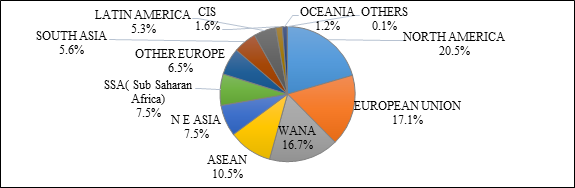
Around 20% of India’s exports go to North America, especially the US and around 17 to 18% goes to EU markets – these have remained the most important markets for Indian engineering exports.
Given the over dependence on North America and EU markets, it is understandable that the US imposed reciprocal tariff of 50% have weighed in on India’s export interests in the US. Additionally, the rising threat of CBAM in the EU and imposition of sudden safeguard duties in response to US tariffs has also impacted India’s exports to the EU. This is evident from India’s export figures in the current fiscal– In October alone, India’s engineering exports dropped by 16.7%. It was led by the US where exports declined by 14.5% and EU where it declined by 18%.
Region-wise shares of India’s engineering exports during April-March 2024-25
Source: DGCI&S
| Trade Flow | Export figures (in US$ billion) | % Growth | ||||
|---|---|---|---|---|---|---|
| Oct-2024 | Oct-2025 | Apr - Oct 2024-25 | Apr - Oct 2025-26 | Oct 2025 over Oct 2024 | Apr-Oct 2025 over Apr-Oct 2024 | |
| Engineering Exports | 11.25 | 9.37 | 67.60 | 68.73 | -16.71% | 1.68% |
| Overall Merchandise Exports | 38.98 | 34.38 | 252.66 | 254.25 | -11.82% | 0.63% |
Source: DGCI&S
With Indian exporters facing challenges in major export markets, trade diversification emerges as an important way out.
Reaching India’s ambitious export target amidst the rising volatility
Decline in India’s exports and dealing with the crisis
Also, by 2030, EEPC India envisions steering India’s engineering exports to US$ 250 billion, cementing engineering as a strong pillar of India’s merchandise exports and aligning with the Government of India’s ambitious US$ 1 trillion merchandise export target. To reach this ambitious target, EEPC India had suggested a 5E Framework in its recent strategy paper.
By 2047, as India enters its Amrit Kaal, EEPC India aspires to drive engineering exports beyond US$ 1.25 trillion, making India a major global hub for engineering goods and services and contributing significantly to the Government’s vision of US$ 5 trillion merchandise exports.
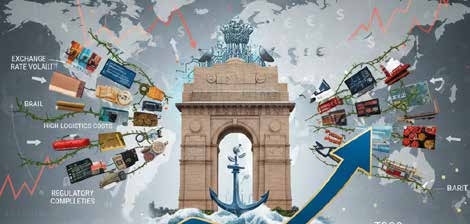
In this regards, the Indian exporting community put forward certain demands to the government. Some of the major aspects of this demand include:
- Reinstatement of Interest Equalization Scheme: Access to affordable export financing has been a persistent challenge for MSMEs. The Interest Equalisation Scheme (IES) provided significant relief by lowering borrowing costs for exporters. However, its discontinuation after 2024 has led to a substantial increase in financing costs. The industry has urged for the reintroduction of IES with the aim to enhance their competitiveness, especially in a turbulent trade environment
- Market Access Initiatives (MAI): Financial support through MAI is of great significance as it requires a substantial operational cost to exhibit products in foreign soil through trade exhibitions. It is a major catalyst for trade diversification as mentioned above and there have been examples where exporters have been able find buyers in new markets though MAI supported event participation. Despite this, fund allocation under MAI has been reduced over the years although the present shift in global trade patterns demand much higher allocation over the years. Moreover, there are pending MAI dues that are adversely impacting the business of MSMEs. It is therefore important to have adequate allocation of fund under this scheme.
- Reimbursement for Obtaining Testing Certificates for MSMEs: Obtaining quality and product certification is a cumbersome as well as costly procedure that affect the operation cost of MSME badly as they are already under financial stress and make compliance in global market difficult for them. Industry has also urged for some reimbursement for testing charges so that testing does not become burdensome for MSMEs.
Driving exports through Export Promotion Mission
The recently announced Export promotion Mission by the Government of India tries to address the above requests by the industry, boost India’s exports and increase our competitiveness in the global trade. In the below section, we briefly mention the various aspects of this policy. The policy is expected to act through two specific sub-schemes:
Niryat Protsahan:
The aim of this is to strengthen India’s trade finance ecosystem. It also aims to address the issue of unavailability of export credit through timely, affordable and diversified trade finance options. The major features of this scheme include:
- Interest subvention for pre and post-shipment credit to help MSMEs avail credit/liquidity at an affordable rate
- Promoting alternative trade instruments such as export factoring and deep tier financing
- For E-commerce exporters special credit cards to compensate for the lack of availability of traditional finance sources
- To enable smoother and more inclusive access to credit, collateral support for export credit
- To enable Indian MSMEs reach new and high-risk markets through access to shared risk and credit enhancement opportunities
Niryat Disha
The aim of this scheme is to enhance India’s export capacity by building export capabilities, addressing non-tariff barriers and favourably positioning India’s products in key global markets. The various aspects of this scheme are:
- Support for export quality and technical compliance to bridge the gap of compliance cost
- Support for market access to enhance India’s global reach and competitiveness
- Support for export warehousing aimed at improving export fulfillment and reducing logistics cost through shared infrastructure
- Support for inland transport and handling to offset higher logistics costs for exporters in low-export- intensity districts
- Support for export branding and packaging aimed at enhancing India’s export identity through unified branding, packaging and sectoral or area-specific campaigns
- Support for trade facilitation and intelligence aimed at strengthening institutional and digital capacities of MSMEs , industry associations, clusters and district-level bodies
Apart from the above sub-schemes, the government has also announced additional targeted relief measures to safeguard exports from recent trade volatilities. These are:
- Moratorium on term loan payment and deferment of interest on working capital loans for a period of time between September 2025 and December 2025 to provide immediate relief to those sectors which are significantly affected by the global uncertainty
- The deadline for exporters to realize and repatriate export proceeds has been extended from 9 months to 12 months providing flexibility to exporters to manage delayed payments and supply-chain disruptions
Importance of MSMEs and the Challenges Faced by them
The Micro, Small and Medium Enterprises (MSME) are crucial contributors to India’s exports including engineering. This sector is significant for inclusive industrial development of the country, contributing around 30% to India’s GDP and nearly 45% to the country’s total exports1. Despite their critical role, MSMEs face persistent challenges that limit their competitiveness in international markets:
- Access to information – Many MSMEs lack timely access to critical information on business opportunities, policy changes, quality standards, global regulations, and trade procedures.
- Financial constraints – Rigid eligibility criteria, high collateral requirements, and low financial literacy make securing loans difficult.
- High input and energy costs – Steel prices and power tariffs are major cost drivers.
- Quality and compliance – Matching global standards requires targeted handholding, technology upgrades, and compliance with stringent quality and sustainability norms.
- Global integration – To accelerate MSME internationalization, the industrty advocates for favourable policies, promotes skill development, and encourages digital onboarding to connect MSMEs with global supply chains.
Empowering MSMEs through the Credit Guarantee Scheme
From the above discussion it is evident that MSMEs face significantly high cost of exports and affordable export credit remains a challenge. To address this the Government approved the introduction of Credit Guarantee Scheme for Exporters (CGSE) to provide 100% credit guarantee coverage through the National Credit Guarantee Trustee Company Ltd. (NCGTC) to Member Lending Institutions for extending additional credit facilities of up to ₹20,000 crore to eligible exporters, including MSMEs. The scheme is available up to 31st March 2026 and can be availed by exporters after fulfilling the minimum export criteria in the previous financial year.
The scheme aims to ease shortterm liquidity stress by supporting exporters who require additional working capital to tide over any short term mismatches and to explore new potential markets. It covers both direct and indirect exporters and allows loans up to ₹50 crore for a tenor of 1+3 years. The key features of the scheme include
- Up to 20% additional working capital limits,
- No guarantee fee and no additional collateral requirement
- The scheme will remain valid up to 31.03.2026 or until guarantees amounting to ₹20,000 crore are issued, whichever is earlier
Conclusion
The announcement of the Export Promotion Mission and the Credit Guarantee Scheme has been fervently welcomed by the exporting community who are now eagerly awaiting its implementation. The policy can act as a powerful catalyst in strengthening India’s position in the global market by enhancing the competitiveness of Indian exporters mostly MSMEs. It promotes a focused and collaborative approach between the various stakeholders of trade including the exporters, government and financial institutions and is the right step at a time amidst the continually evolving global trade scenario. As India strives to become a global manufacturing and trade hub, the Export Promotion Mission could be the engine powering it.



© Copyright , All rights reserved. Design by Andreal