







VOL. 18, ISSUE NO. 1 | April 2025

Focus





INTRODUCTION
Machine tools are extremely significant for engineering sector as it supplies machinery for all manufacturing sectors. It is also an integral part of India’s capital goods industry which serves as a strong base for its contribution to sectors including engineering, construction, infrastructure and consumer goods. The Indian machine tools industry has performed well in the last few years. The industry has recorded a growth of 32% year-on-year in 2022-23. During the same period, consumption has also increased by 55%. India currently ranks 9 in Production and 7th in Consumption, globally, as per estimates from Gardner Intelligence’s World Machine Tool Survey 2022. The infrastructure push by the government of India along with the PLI scheme have been major drivers of India’s machine tools industry. Also increase in demand in automobile sector especially in electrical vehicles (EVs) has been a driving force. The industry is projected to grow at 12% to 17% in the next three years. Various types of machine tools currently manufactured in India include General/Special Purpose Machines, Standards CNC machines, Gear cutting, Grinding, Medium sized machines, EDM, Presses, Press Brakes, Pipe Bending, Rolling, Bending, Measuring, metrology and gauging, etc.
INDUSTRY COMPOSITION
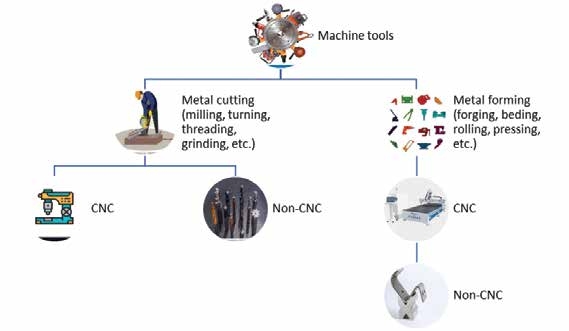
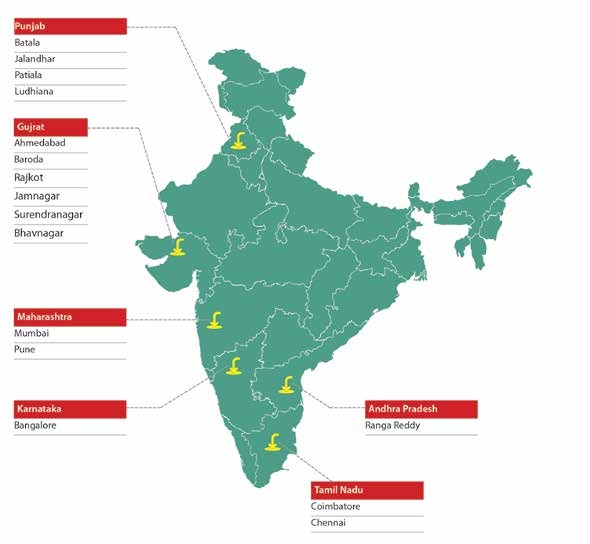
Metal cutting machine tools industry plays a very important role in Indian manufacturing industry with 80% of India’s machine tool demand generating in metal cutting machine tools. India also has some import dependency in metal cutting machines with 47% of the total demand being imported. Metal forming machines also play a prominent role in India’s manufacturing although it constitutes 20% of the total machine tools demand in India. Growth in auto and auto component industries have driven the growth of metal cutting machines in India. About 90% of the total production of metal cutting machines take place in Bengaluru, Pune, Mumbai, Ahmedabad and Chennai.
The industry has around 1000 units involved in the production of various types of machine tools and their accessories and parts. While the large companies account for 70% of the turnover, most companies are located in the medium and small segments. Metal forming machineries serve as the chief manufacturing machinery in industries such as consumer durables, automobile and electronics. Other industries which require metal forming machines include aerospace, power, construction, railways, heavy transportation, office furniture, instrumentation industry, steel industry, forging, and structural engineering. Most metal forming machineries in India are manufactured in Baroda, Coimbatore, Jalandhar, Pune and Ludhiana.
MACHINE TOOLS CLUSTERS IN INDIA
| HS code | Product description |
| A. Metal cutting machines | |
| 1. Lathes | |
| 84581100 | Horizontal lathes, numerically controlled |
| 84581911 | Automatic, single spindle horizontal bar, swiss type |
| 84581912 | Automatic, single spindle, bar sliding head type |
| 84581913 | Automatic, single spindle horizontal chucking |
| 84581919 | Other automatic, single spindle horizontal lathes |
| 84581990 | Other horizontal lathes |
| 84589100 | Other numerically controlled lathes |
| 84589910 | Automatic, multi-spindle bar |
| 84589920 | Automatic, multi-spindle chucking |
| 84589931 | Capstans |
| 84589932 | Turrets |
| 84589933 | Capstan & turret combination |
| 84589934 | Copying lathes |
| HS code | Product description |
| 84589935 | Multi-tool and production |
| 84589941 | Crank shaft |
| 84589942 | Relieving |
| 84589943 | Wheel and axle |
| 84589951 | Centre lathes, tool-room type |
| 84589959 | Centre lathes, others |
| 84589990 | All other lathes excl centre lathes |
|
2. Boring-milling machines |
|
|
84572010 |
Unit head boring |
| 84593100 | Boring-milling machines, numerically controlled |
| 84593910 | Vertical turning or boring |
| 84593990 | Others |
| 84594010 | Jig, boring machines, horizontal |
| 84594020 | Fine boring machines, horizontal |
| 84594030 | Fine boring machines, vertical |
| 84594090 | Others |
| 84595110 | Horizontal |
| 84595120 | Vertical |
| 84595130 | Universal |
| 84595190 | Other numerically controlled knee-type milling machines |
| 84595910 | Horizontal |
| 84595920 | Vertical |
| 84595930 | Universal |
| 84595940 | Ram type |
| 84595950 | Die-sinking or pantograph |
| 84595990 | Others |
| 84596110 | Piano milling |
| 84596190 | Others |
| 84596910 | Bed type, horizontal |
| 84596920 | Bed type, vertical |
| 84596930 | Piano milling, single column |
| 84596940 | Plano milling, double column |
| 84596990 | Others |
| 84614019 | Gear cutting & generating machines n.e.s. |
| 84614021 | Gear grinder single/double wheel disc type |
| 84614022 | Gear grinder, formed wheel |
| 84614023 | Gear shaver |
| 84614024 | Gear tooth, rounding, chamfering/burring |
| 84614025 | Gear shaper, spur & helical |
| 84614026 | Gear hobber, spur & helical |
| 84614029 | Other gear finishing machines |
| 9. Sawing machines | |
| 84615011 | Band saw, horizontal |
| 84615012 | Band saw, vertical |
| 84615013 | Circular saw, cold |
| 84615014 | Circular saw, hot |
| 84615015 | Hack saw |
| 84615019 | Other sawing machines |
| 10. Other cutting and sawing machines | |
| 84615021 | Abrasive wheel cutting-off machines |
| 84615029 | Other cutting-off machines |
| 84619000 | 0ther machine tools of heading no 8461 |
| 84641010 | Granite cutting machines, equipment etc |
| 84641090 | Other sawing machines |
| 84642000 | Grinding/polishing machines working stone etc |
| 84649000 | Other machine-tools of heading 8464 |
| 84609010 | Polishing & buffing machines |
| 84609090 | Others |
| 11. Shaping and slotting machines | |
| 84612011 | Die & punch shaping machines |
| 84612019 | Other shaping machines |
| 84612020 | Slotting machines excl for gears |
| 84612011 | Die & punch shaping machines |
| 84612019 | Other shaping machines |
| 84612020 | Slotting machines excl for gears |
| 12. Other metal cutting machines | |
| 84561000 | Machine-tools operated by laser/other light or photon beam processes |
| 84562000 | Machine-tools operated by ultrasonic processes |
| 84563000 | Machine-tools operated by electro-discharge process |
| 84569100 | Other machine-tools for dry-etching patterns on semiconductor mate- rials |
| 84569910 | Electro-chemical machines |
| 84569990 | Others |
| HS code | Product description |
| B. Metal forming machines | |
| 84621011 | Hammers, steam/air, single frame |
| 84621012 | No record found |
| 84621013 | Hammers, headers & upsetters |
| 84621014 | Hammers, double acting counter blow ,air/steam |
| 84621019 | Other hammers |
| 84621020 | Forging machines, n.e.s. |
| 84621030 | Stamping machines, metal working |
| 84622100 | Numerically controlled bending, folding, straightening /flattening ma- chines(including presses) |
| HS code | Product description |
| 84622910 | Bending&/or straightening machines |
| 84622920 | Press brakes |
| 84622930 | Rotary head & ram type |
| 84622990 | Others |
| 84623100 | Numerically controlled shearing machines(including presses),excluding combined punching & shearing machines |
| 84623910 | Plate & sheet shears(guillotine) |
| 84623920 | Bar & angle shearing & cropping |
| 84623990 | Others |
| 84624100 | Numerically controlled punching/notching machines (including presses),including combined punching & shearing machines |
| 84624910 | Punching machines (including turret) |
| 84624920 | Combination of punching, shearing and cropping machines |
| 84624930 | Nibbling machines |
| 84624990 | Other punching & notching machines |
| 84629110 | Hydraulic extension |
| 84629190 | Others |
| 84629911 | Pneumatic presses |
| 84629912 | Inclinable presses |
| 84629913 | Vertical gap of frame presses |
| 84629914 | Vertical straight presses |
| 84629915 | Vertical forging presses |
| 84629919 | Other machine tools (including presses) |
| 84629920 | Dyeing /lobbing machine presses |
| 84629930 | Transfer & multiple presses |
| 84629940 | Horizontal presses |
| 84629950 | Friction screw presses |
| 84629960 | Knuckle joint presses |
| 84629970 | Coining joint presses |
| 84629990 | Other presses (mechanical & manual) |
| 84631010 | Wire & metal ribbon drawing machines |
| HS code | Product description |
| 84631020 | Wire making machines |
| 84631030 | Tube drawing machines |
| 84631090 | Others |
| 84632000 | Thread rolling machines |
| 84639010 | Riveting machines(excl portable hand) |
| 84639020 | Strip profiling |
| 84639030 | Seaming machine (e.g. for cans) |
| 84639090 | Others |
| C. Metal working machines | |
| 84572090 | Other unit construction machines ,single station |
| 84573010 | Rotary type multi-station transfer machines |
| 84573020 | In-line type multi-station transfer machines |
| 84573090 | Other multi-station transfer machines |
| 84591000 | Way-type unit head machines |
| 84651000 | Machines which can carry out different types of machining operations without tool change between such operations |
| D. Machining centres | |
| 84571010 | Machining centres horizontal |
| 84571020 | Machining centres - vertical |
| E. Machine tools for wood working | |
| 84659100 | Sawing machines for working wood ,cork ,bone etc |
| 84659200 | Planning, milling/moulding machines for working wood etc |
| 84659300 | Grinding/polishing machines for working wood, cork etc |
| 84659400 | Bending/assembling machines for working wood etc |
| 84659500 | Drilling/morticing machines |
| 84659910 | Lathes for working wood etc |
| 84659990 | Others |
| F. Pneumatic machine tools | |
| 84671110 | Pneumatic drills |
| 84671120 | Pneumatic hammers |
| 84671190 | Other pneumatic rotary type tools for working in hand |
| 84671900 | Others pneumatic tools |
| G. Machines with self-contained electric motor | |
| 84672100 | Drills with self- contained electric motor |
| 84672200 | Saws with self-contained electric motor |
| 84672900 | Other machines with self-contained electric motor |
| 84678100 | Chain saws for working in hand |
| H. Other machine tools | |
| 84678910 | Grease guns, lubricators etc. |
| 84678920 | Vibrators, non-electric |
| 84678990 | Others |
| 9. Parts and accessories of machine tools | |
| 84661020 | Self-opening dye-heads |
| 84662000 | Work holders |
| 84663010 | Chucks, mechanical/pneumatic |
| 84663020 | Jigs & fixtures for machine-tools |
| 84663090 | Others |
| 84669100 | Parts & accessories for machines of heading no. 8464 |
| 84669200 | Parts & accessories for machines of heading no.8465 |
| 84669310 | Parts and accessories of machine-tools, for working metals |
| 84669390 | Other parts accessories, attachment for machine-tool |
| 84669400 | Parts & accessories for heading no.8462/8463 |
| 84679100 | Parts of chain saws |
| 84679200 | Parts of pneumatic tools |
| 84679900 | Parts of other tools for working in hand |
EXPORT TREND IN INDIA’S MACHINE TOOLS INDUSTRY
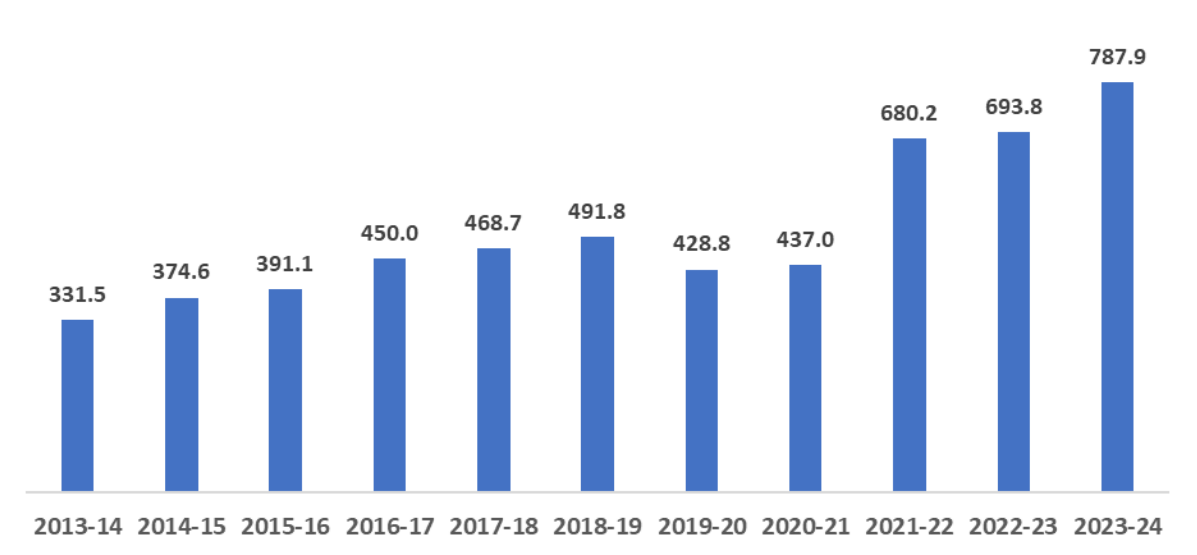
Since last 10 years between 2013-14 and 2022-23, India’s machine tools exports increased at a CAGR of 8.6%. Even in the current fiscal (April-November 2023-24), India’s machine tools exports increased by 7.6% in y-o-y basis. The figure below indicates the export trend in machine tools in the last 10 years
More than 20% of India’s machine tools exports are sent to South East Asia, followed by EU and Africa. The Gulf countries are also emerging as potential destinations. The figure below indicates the regional spread of India’s machine tools industry. Also in Table 1 we have indicated the top 10 export markets for Indian machine tools industry
Figure 1: India’s Machine Tools Export Trend in the last 10 years (USD Mn.)
Source: DGCI&S
| Top export destinations | India’s exports, 2022-23 | India’s exports, 2023-24 | Growth % |
| U S A | 178.50 | 190.31 | 6.62 |
| RUSSIA | 14.12 | 76.12 | 438.98 |
| GERMANY | 56.93 | 57.05 | 0.21 |
| UAE | 28.98 | 39.22 | 35.33 |
| CHINA | 36.67 | 37.54 | 2.38 |
| BELGIUM | 27.39 | 36.31 | 32.55 |
| ITALY | 37.67 | 29.40 | -21.96 |
| MEXICO | 14.02 | 21.01 | 49.89 |
| NETHERLAND | 23.00 | 19.03 | -17.27 |
| TURKEY | 9.58 | 17.52 | 82.83 |
In the global market, China and developed countries such as Germany, Japan and USA are the champions in terms of machine tools exports. India ranks 28 in the global list of machine tools suppliers. Table 2 indicates India’s contribution in the machine tools import of its top export markets.
GOVERNMENT SCHEMES IN INDIAN MACHINE TOOLS INDUSTRY
The government of India has introduced a number of policies for the advancement of Indian capital goods industry which is expected to benefit the machine tools sector. The major schemes are highlighted below:
1. Scheme for Enhancement of Competitiveness in Indian Capital Goods Sector –Phase I & II The first phase of the Capital goods Scheme was introduced in 2014 with an outlay of INR 995.96 crore. It was launched to address the skill gaps and infrastructural gaps in India’s capital goods industry. The outcome of the Scheme has proved the efficacy of the strategies deployed for technology and industrial infrastructure development. The salient features of the first phase include
India’s top importers |
Global import 2023 |
Top 5 suppliers and share % |
India’s rank |
U S A |
17.28 |
China (18.7), Germany (13.2), Japan (13.0), Vietnam (8.3), Taipei (8.2). India (0.96) |
15 |
RUSSIA |
Updated data not available |
||
GERMANY |
7.09 |
China (21.6), Switzerland (14.5), Austria (7.1), Japan (6.7), Italy (5.8), India (0.7) |
24 |
UAE |
0.5 |
China (37.7), Italy (8.6). Germany (7.9), USA (7.8). India (5.4) |
5 |
CHINA |
7.13 |
Japan (29.8), Germany (26.6), Taipei (14.3), Switzerland (4.8), Italy (4.7). India (0.47) |
19 |
- Centre of Excellence: 8 CoEs have been established wherein 25 new technologies in the field of machine tools, textile machinery, earth moving machinery, nano and sensor technologies have been developed at national research institutes of eminence such as Indian Institute of Technology (IITs), Indian Institute of Sciences (IISc), Central Manufacturing Technology Institute (CMTI) etc and a number of these technologies has been commercialized.
- Common Engineering Facility Centres: 15 such centres including four Smart Advanced Manufacturing and Transformation Hub (SAMARTH) centres and six web-based technology innovation platforms have been set up. The platforms are bringing India’s technical resources and the concerned industry in one common platform to identify and facilitate a solution for the technological needs of the industry
- Technology Acquisition Fund Programme
- Also, an exclusive industrial park for machine tool industry has been developed across 530 Acres, at Tumkuru, Karnataka. So far, out of 336 acres of allottable land, 145 acres of land has been allotted
to the machine tool manufacturers. The salient features of the Machine Tools Park are follows:
- » The Park has state of art infrastructure consisting of Green Cover Area, Incubation, Test & Certification Centre & Common Engineering Facilities Centre to improve productivity and create new capacities across the supply chain.
- » It is a step forward in making the machine tool sector cost effective, hi-tech machine tools, enhanced export capability and attracting more investment.
- » It will encourage investment in technology upgradation, skill development and augmentation of modern manufacturing capacities for holistic growth of Industry and SMES, Startup, R & D, incubation Centre etc
- » It will help to improve the Economy of the Country/State, GDP/GSDP and employment generations (directly and indirectly).
- » It will also help to reduce the imports of Capital Goods and improve the Forex Reserves.
The second phase of the scheme was launched in January 2022 whereupon the first phase incentives were merged with it. The second phase aimed to expand the positive impact of the first phase of the Capital Goods Scheme. The scheme has a financial outlay of Rs. 1207 crores with Budgetary support of Rs.975 crore and Industry Contribution of Rs.232 crores. A total of 32 projects have been sanctioned so far under the Phase-II of the Scheme for Enhancement of Competitiveness in the Indian Capital Goods Sector. There are six components under the Scheme for Enhancement of Capital Goods Sector Phase II and the details of the projects sanctioned so far are as follows:
- Setting up of New Advanced Centres of Excellence and augmentation of Existing Centres of Excellence To expedite R&D by utilizing academia of repute and private industry which is involved in research and development activities.
- Setting up of Common Engineering Facility Centres (CEFCs) and augmentation of existing CEFCs For creating demonstration & training, consultancy, hand holding and R & D services and awareness programmes to industrial units.
- Promotion of skilling in Capital Goods Sector –Creation of Qualification packages for skill levels 6 and above- in association with Skill Councils for skills level 6 and above.
- Augmentation of Existing Testing and Certification Centres- to address the needs of Capital Goods Sector & Auto sector for testing of machinery in terms of various properties relating to mechanical, electrcal, chemical, structural, metallurgical, electronics aspects etc.
- Setting up of Industry Accelerators for Technology Development - Aimed at development of targeted indigenous technologies, scaled to meet the requirements of selected industry segment, which till now has been dependent on imports. Selected Academic Institute/ Industry Body will act as an Accelerator for fostering the development of such technologies.
- Identification of Technologies through Technology Innovation Portals -Six Web-based open manufacturing technology innovation platforms have been developed under CG Scheme Phase-I. These are being supported under CG Scheme Phase-II.
For more details please visit: https://static.investindia.gov.in/s3fs-public/2022-01/Notification for Capital Goods Phase II .pdf
2. National Capital Goods Policy: Indian Capital goods Policy launched in 2016 also included machine tools as one of its sectors and was aimed at making the sector globally competitive. For machine tools the scheme envisaged:
- Supporting industry to develop and manufacture high technology and high value products and critical components and raw materials
- Encouraging acquisition of potential overseas companies
- Omitting machine tools from critical trade agreements especially those with strong countries
- Developing “technology centres” in key markets such as Thailand, Turkey, Brazil and Mexico
- Providing greater incentive for technology development especially among MSMEs
- Enhancing depreciation and investment allowance
For more details please visit: https://heavyindustries.gov.in/sites/default/files/2023-07/Capital-Goods-Policy-Final.pdf
3. Ministry of MSME Schemes There are a number of Ministry of MSME schemes which also benefits the machine tools industry. These include:
- Technology and Quality Upgradation Support for MSMEs: The scheme advocates the use of energy efficient technologies (EETs) in manufacturing units so as to reduce the cost of production and adopt clean development mechanism.
- Enabling manufacturing sector to be competitive through adopting latest Quality management Standards (QMS) and Quality Technology Tools (QTT).
- Financial support for MSMEs in Zero Defect zero Effect (ZED) certification scheme
THE GLOBAL HAND TOOLS INDUSTRY
The global hand tools market has experienced substantial growth in the recent years due to growth of some of its end-user industries including construction, automotive, etc. Increasing Do It Yourself (DIY) activities especially drilling, hammering and sawing are also driving the market. As per recent market research report, global hand tools industry was valued at USD 21.85 billion in 2021 and is expected to grow at a CAGR of 4.3% between 2021 and 2030.
As mentioned above, increasing DIY activities are one of the main drivers of the global hand tools market. Hence general purpose tools which are easy to use and do not need much technical skill accounts for the largest market share. In 2021, the share of general purpose tools in total global hand tools market was 66.6%. Recent market reports also forecast that cutting tools category including saws, chisels, knives and blades and cable and wire cutting tools would experience highest growth among all hand tools categories. Globally hand tools markets in the Asia pacific region (APAC) are expected to exhibit maximum growth in the coming years.
STRUCTURE OF THE INDIAN HAND TOOLS INDUSTRY
The Indian Hand Tools industry is also experiencing a positive growth trend. As per recent statements by the Ministry of MSME, Indian Hand Tools market is valued at USD 342.8 million in 2022 and is projected to reach USD 416.2 million by 2029 growing at a CAGR of 4.3%. Additionally the Industrial fastener market is expected to hit USD 460 billion by end of 2023, exhibiting a CAGR of 9.6% over 2018.
The Indian hand tools market has approximately 2500 manufacturers out of which more than 90% are in the MSME category. The market is fragmented wherein most of the few big players are responsible for maximum revenue share. The sector has a total investment of around INR 5000 million and employs estimated 25000 workers.
Major segments of the industry

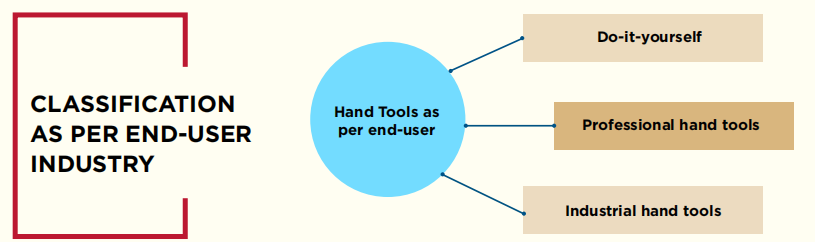
THE TABLE BELOW LISTS THE DIFFERENT TYPES OF HAND TOOLS AND CUTTING TOOLS AS PER HS CODES:
| HS code | Product description |
| Garage or Workshop Tools | |
| 82041110 | Hand-operated spanners non adjustable |
| 82041120 | Hand-operated wrenches (excluding tap wrenches) non-adjustable |
| 82041210 | Hand-operated spanners-adjustable |
| 82041220 | Hand-operated wrenches(ex-tape wrenches)adjustable |
| 82042000 | Interchangeable spanner sockets, with handle or not |
| 82055910 | Grease guns (excluding compressed air type) |
| 82060010 | Garage tools in sets |
| Glass cutting tools | |
| 82055990 | Other hand tool including glazier’s diamonds nes |
| Household tools | |
| 82055110 | Can or cork openers |
| 82055190 | Other household hand tools |
| Metal working tools | |
| 82055920 | Metal working hand tools |
| 82059000 | Sets of two or more subheadings of 8205 |
| 82056000 | Blow lamps |
| 82057000 | Vices, clamps & the like |
| Other hand tools | |
| 82032000 | Pliers, pincers ,tweezers & similar tools |
| 82054000 | Screwdrivers |
| 82052000 | Hammers & sledge hammers |
| 82060090 | Other tools of two or more of heading no. 8202 to 8205 put up in sets for retail sale |
| Hand tools for wood cutting and watchmaking | |
| 82053000 | Planes, chisels, gauges & similar cutting tools for working wood |
| 82055930 | Hand tools for specified uses, such as, watch making tools, goldsmith tools |
EXPORT TREND IN INDIA’S HAND TOOLS INDUSTRY
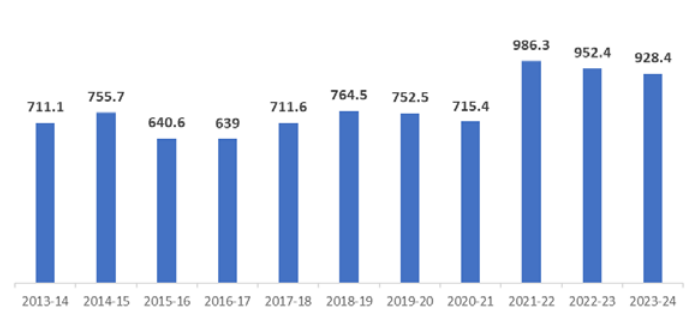
Since the last 10 years that is between 2013-14 and 2022-23 India’s hand tools exports increased at a CAGR of 3.3% although in the current fiscal (April-November 2023-24), India’s machine tools exports decreased by 5% in y-o-y basis. The figure below indicates the export trend in hand tools in the last 10 years.
Around 30% of India’s hand tools exports are sent to North America, followed by EU and WANA. ASEAN also has significant potential as export market. Also in Table 1 we have indicated the top 10 export markets for Indian hand tools industry.
Source: DGCI&S
In the global market, China and developed countries such as Germany, USA, etc are the champions in terms of hand tools exports. India ranks 14 in the global list of hand tools suppliers. Table 4 indicates India’s contribution in the hand tools import of its top export markets.
Table 3: Top 10 export destinations of India’s hand tools and cutting tools (USD million)
| Top Export Destinations | India’s Exports in 2022-23 | India’s Exports in 2023-24 | Growth % |
| U S A | 252.74 | 258.91 | 2.44 |
| NETHERLAND | 76.05 | 61.92 | -18.59 |
| GERMANY | 63.97 | 59.94 | -6.30 |
| RUSSIA | 26.50 | 38.78 | 46.36 |
| U ARAB EMTS | 48.32 | 37.36 | -22.68 |
| BELGIUM | 20.77 | 32.53 | 56.58 |
| AUSTRALIA | 33.34 | 30.28 | -9.16 |
| SINGAPORE | 32.78 | 30.18 | -7.93 |
| U K | 28.89 | 28.18 | -2.47 |
| BRAZIL | 17.66 | 21.13 | 19.63 |
source: DGCI&S
| India’s top importers | Global import, 2023 | Top 5 suppliers and share % | India’s rank |
|
U S A |
9.07 |
China (29.2), Taipei (11.3), Germany (9.8), Japan (8.1), South Korea (4.5), India (3.6) |
8 |
|
NETHERLAND |
1.65 |
Germany (30.0), China (17.0), Belgium (7.0), Sweden (6.6), Japan (4.9), India (1.2) |
14 |
|
GERMANY |
5.4 |
China (24.4), Switzerland (13.7), USA (5.75), Austria (5.0), Czech Republic (4.9), India (1.9) |
15 |
|
RUSSIA |
Updated data not available |
||
|
UAE |
0.45 |
China (35.2), USA (14.3), Germany (8.8), India (6.5), Italy (5.01) |
4 |

GOVERNMENT SCHEMES IN INDIAN HAND TOOLS AND CUTTING TOOLS INDUSTRY
The government of India has introduced a number of policies for the advancement of Indian capital goods industry which is expected to benefit the machine tools sector. The major schemes are highlighted below:
- Setting up Central Institute of Hand Tools Central Institute of Hand Tools (MSME Tool Room, Jalandhar) is a premier organization responsible for the development of Hand Tool Industry in the country. Government of India has set up Central Institute of Hand Tools as a National Institute in Jalandhar (Punjab) as an autonomous organization with the assistance of U.N.D.P. and Govt. of Punjab in the year 1983, with a view to provide trained manpower and technology support services to engineering industry in general & the hand tools industries in particular. The institute is ISO-9001:2008, ISO-14001:2004 certified and having NABL accredited Lab. Objective of the scheme includes
- » Trained personnel for the industry to adopt improved technology in product design, production technologies, testing & quality control techniques, packing & product development.
- » Design of tools, not manufactured by the industries and prototype development
- » Common facility services for forging, dies, tools, jigs and fixtures.
- » Consultancy services leading to setting up of turnkey projects.
- » Assistance of the small and medium scale industries in the design and development, manufacture of dies, heat treatment of tooling for Hand Tools.
- National Programme for promoting energy efficiency in hand tools SSI sector in India
This is in partnership with DC (SSI), UNIDO, SIDBI, Hand Tool Manufacturers Associations. The objectives of the scheme are:
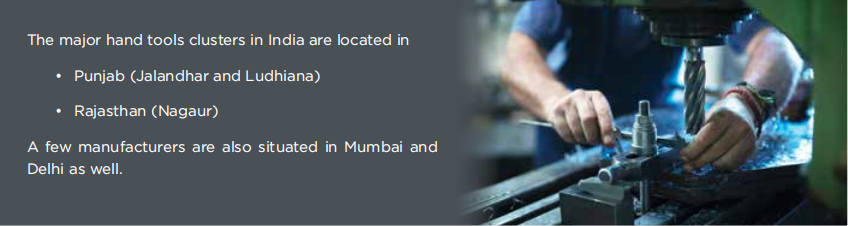
- Technology upgradation of Hand Tool SSI clusters at Jallandhar (Punjab) and Nagaur (Rajasthan) by adopting energy efficient & clean technology and other measures.
- Strengthening of Institutional structure & capacity building of CIHT, Jalandhar and HTDDTC, Nagaur.
- Strengthening of Policy framework to promote replication of energy efficient technologies demonstrated.
- Developing an international marketing strategy & support measures for export promotion to enhance the export share of SSI units in the world market.
CONCLUSION
The Indian machine tools and hand tools industries have significant potential in terms of exports. However, India’s contribution in global export is very low - merely 0.6% in case of machine tools and around 1.2% for hand and cutting tools. India is far behind its peers including China and EU countries. To increase India’s share in the global market both trade creation and trade diversification would be important. It is important for the industry to look out for new markets and also upgrade the quality and technology of the products. Also, with the support from the government we are hopeful that India’s tools export will only exhibit a rising trend in the future.

MARKET OVERVIEW AND GROWTH
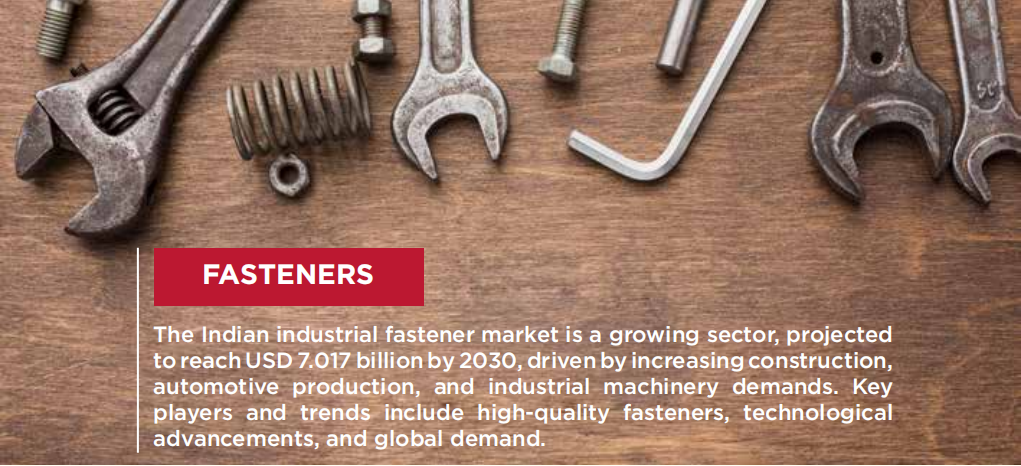
- Market Size: The Indian industrial fasteners market generated a revenue of USD 4,338.4 million in 2024 and is expected to reach USD 7,017.2 million by 2030
- CAGR: The market is expected to grow at a CAGR of 8.4% from 2025 to 2030.
- Growth Drivers:
- » Increasing construction activities, including residential and commercial projects, and government smart city initiatives.
- » Rise in automotive production demands.
- » Overall expansion of industrial machinery
- »Development of fasteners applications for manufacturing automotive parts
Key Players:
- » Deepak Fasteners Limited (DFL)
- » TorqBolt Inc
- » Jyoti Engineering (Jyoti)
- » Big Bolt Nut
- » Boltport Fasteners (BPF)
- » Kova Fasteners Pvt. Ltd.
- » Singhania International Limited (STURDFIX/SFX)
- » Kaloti Group of Companies
- » Ananka Fasteners Manufacturers
- » Caliber Enterprises
- » Bhavya Industries
- » Avlock India
Trends:
- » Focus on high-quality fasteners and innovative manufacturing methodologies.
- » Technological advancements in fastener manufacturing.
- » Global demand for Indian-made fasteners
- » Emphasis on customer satisfaction and meeting specific needs.
- » Forging & Rolling, Ultra-modern Heat Treatment Facility, and high-quality coating.
Challenges:
» Upgrading technologies and capacities regularly to meet global demand.
FASTENER TYPES AND APPLICATIONS
- The market is divided into segments such as screws, nuts, bolts, wafers, anchors, and dowel pins.
- Fasteners are used in various industries, including automotive, construction, aerospace, electronics, and general engineering
- Applications include manufacturing automotive parts like engines, chassis, moulding, suspension systems, and wheels.
MARKET OVERVIEW
Fasteners are made of stainless steel and are used in many businesses to join, fix, or connect two or more things. Most of the time, they are made of carbon steel, metal steel, or stainless steel. They are covered by a paint or coating that keeps them from rusting. The aerospace, industrial machinery, plumbing, motors, and pump businesses are among these.
- Externally threaded dominates the market by product.
- Threaded fasteners dominated the market by type.
- ¼ to ¾ dominated the market by bolt size.
- Automotive dominates the segment by application
- Steel dominated the market by raw materials.
MARKET DYNAMICS
India industrial fasteners market drivers
Growth of the automotive industry
The auto business’s growth drives India’s need for industrial fasteners. Indian automakers like Maruti Suzuki, Tata Motors, and Mahindra & Mahindra use a lot of industrial screws to make their cars. Industrial screws assemble important parts like engines, suspensions, and brakes. Due to the growth of the car industry and other manufacturing sectors, India’s need for industrial fasteners will likely keep going up over the next few years.
India industrial fasteners market restraints
High competition
Indian companies that make fasteners face tough competition from low-cost companies in China and Taiwan. These companies can make fasteners for less money because their labor costs are lower, and they can make more at once. This has caused prices to go up on the Indian market because local makers can’t keep up with their competitors’ lower prices. In the automotive business, for example, Indian companies that make fasteners are having difficulty competing with Chinese companies that can make engine bolts, wheel studs, and other important parts for less money. This is especially hard for Indian manufacturers because the automotive business is one of the biggest users of industrial fasteners in the country.
India industrial fasteners market opportunities
Urbanization and industrialization
As India continues to build cities and factories, the need for infrastructure and building projects is growing quickly. This is a big chance for the Indian industrial fasteners market since fasteners are important parts of building and infrastructure projects. For example, the Smart Towns Mission of the Indian government wants to build 100 smart towns across the country. This will bring in a lot of money for infrastructure and building projects. The Indian government has also started several other projects, such as the Pradhan Mantri Awas Yojana (PMAY), which aims to give everyone a good place to live, and the Sagarmala Project, which aims to improve India’s maritime industry, which will increase demand for industrial fasteners.


© Copyright , All rights reserved. Design by Andreal