







VOL. 19, ISSUE NO. 6 | September 2026

Spotlight





Introduction
The global pharmaceutical machinery industry—encompassing manufacturing, processing, and packaging equipment—is a fast-growing, technology-intensive market valued at approximately USD 21 to 27 billion in FY 2025–26 and projected to reach 6 to 7 percent CAGR by the 2030s. The main driving factors behind the growth of the sector is the rising demand for generics, biologics, and vaccines, stricter GMP (Good manufacturing practice) and regulatory compliance, and increasing automation. Asia-Pacific already accounts for over 40 percent of this market, with India emerging as both a major consumer and an increasingly significant exporter of cost-competitive, GMP-compliant equipment, particularly in not only in medicine but also in mid-range injectable and process machinery. While high-end, highly automated and biophar ma-critical equipment remains dominated by European, Japanese, and some Chinese/Korean suppliers, India’s deep integration with its domestic pharma industry, strong engineering base in various clusters, and export reach to more than 80 countries position it as a strategic, value-oriented player in the global pharma machinery value chain.
India ranks as the second largest manufacturer (approximately 14.5 million kilograms per year) of vaccines only after EU- .Owing to its robust and flexible manufacturing base, the Indian pharma sector can meet domestic demand and contribute to international markets. With the pharmaceutical industry’s continuousexpansion globally and domestically, the outlook for Indian pharma machinery remains promising. India’s strong presence in the global pharmaceutical manufacturing industry, particularly in the production of generic drugs, is fueling demand for pharmaceutical machinery. The country’s focus on increasing self sufficiency in drug production and exports is a significant factor driving market growth.
In this background, this article looks into the current status of India’s pharma machinery exports with respect to global demand. The article briefly looks into the global as well as Indian market, India’s presence in global pharma machinery market and also tries to make some recommendations based on the observations.
Global Scenario of Pharmaceutical Machinery
The pharmaceutical machinery market was estimated to be valued at US$26.8 bn in 2025. It is projected to reach US$49.9 bn by 2035, registering a compound annual growth rate (CAGR) of 6.4percent over the forecast period. The year-on-year (YoY) growth analysis of the pharmaceuticals machinery market shows consistent and significant expansion. This upward trend highlights a growing demand for advanced machinery in the pharmaceutical sector, as global drug production volumes rise and the need for efficient, high-quality manufacturing equipment continues to increase. The continued growth in this market is likely to be driven by rising healthcare needs, increasing investments in pharmaceutical production, and the ongoing shift toward more complex drug formulations. As the market matures, the adoption of automated, precise machinery is expected to accelerate further, driving growth. This steady YoY increase indicates the continued importance of pharmaceutical machinery in enabling higher production capacities, precision manufacturing and meeting the rising global demand for pharmaceuticals.
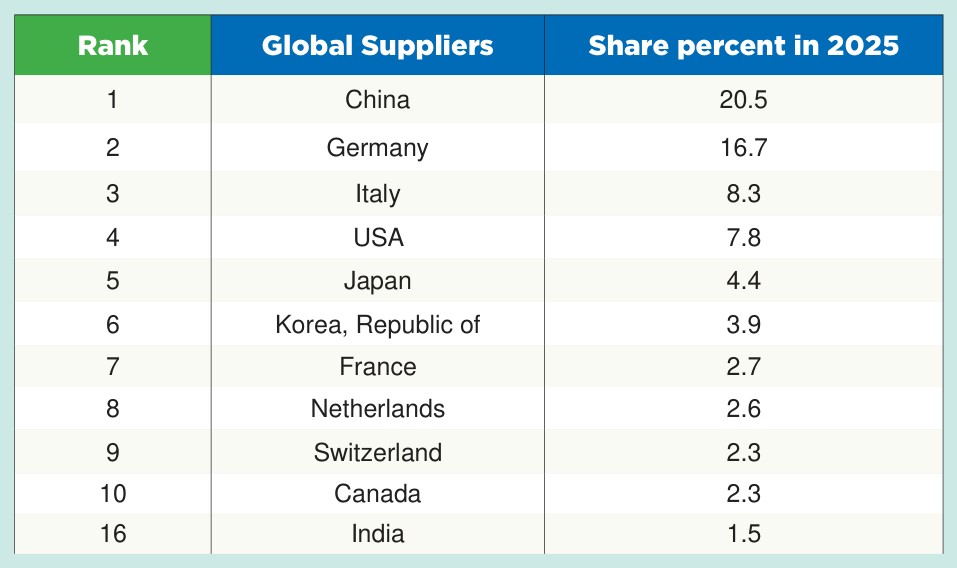
Table 1: Global Suppliers of Pharma Machinery and their Share percent in 2025
Source: ITC Trade Map
From the above table we see that India ranks among the top 20 Global Suppliers accounting for 1.5percent of the total global export of Pharma Machinery. This signifies the potential and scope for India to expand and explore the untapped markets.
India’s Pharma machinery market
The pharma machinery market in India includes a wide range of equipment for pharmaceutical manufacturing, including tablet presses, capsule fillers, and liquid-filling machines, as well as packaging and laboratory equipment. Pharma machinery in India is significant, with numerous manufacturers supplying both domestic and international markets, and it is characterised by growth driven by the country’s large pharmaceutical industry. The cost of manufacturing pharmaceutical machinery in India is the lowest in the world, therefore, giving us the leading edge in the world’s markets.
The pharmaceutical machinery market in India is experiencing robust growth driven by the overall expansion of the domestic pharmaceutical industry, increased R&D investment, and a push for advanced manufacturing technologies like AI and automation. India’s position as a leading pharmaceutical manufacturing hub is driving demand for pharmaceutical machinery. Government initiatives like “Make in India” and the need for increased domestic production capacityare accelerating market growth. The shift towards automation and modernisation in pharmaceutical manufacturing continues to boost the demand for advanced machinery. The outlook for the Indian pharma machinery industry is exceptionally bright. Despite a few challenges, the sector is poised for continued growth and development, thanks to several key factors. The pharmaceutical machinery market in India has been booming thanks to the development of novel biopharmaceuticals, including vaccines and biosimilars, which has increased demand for equipment such as bioreactors, sterile fill-finish lines, and cleanroom systems.
Trade Scenario of Indian Pharma machinery sector:
India currently exports pharmaceutical machinery and equipment to over 80 countries globally. Exports are estimated to contribute ~35percent to the industry turnover. Indian manufacturers have a cost advantage over other pharma machinery hubs, such as those in Germany. Markets in Latin America and the Middle East are increasingly sourcing pharmaceutical machinery and equipment from Indian companies. These markets are relatively underpenetrated and will act as key drivers of growth for the Indian pharma machinery sector.
Figure 1: Overall Trade data for India’s Pharma machinery Sector (in USD Bn.)
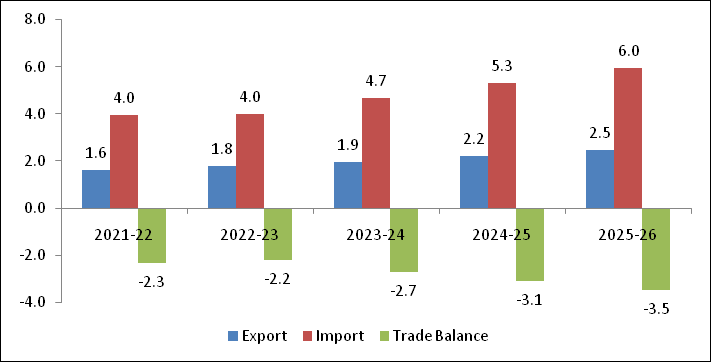
Observation: The above figure depicts India’s overall trade scenario in pharma machinery segment during the last 5 years. From the figure it is evident that exports of pharma machinery in India have increased during the last 5 years at a CAGR of 11.0percent. However, imports during this time also increased by 10.7percent. Overall, India has a negative trade balance in this sector.
Source: DGCI&S
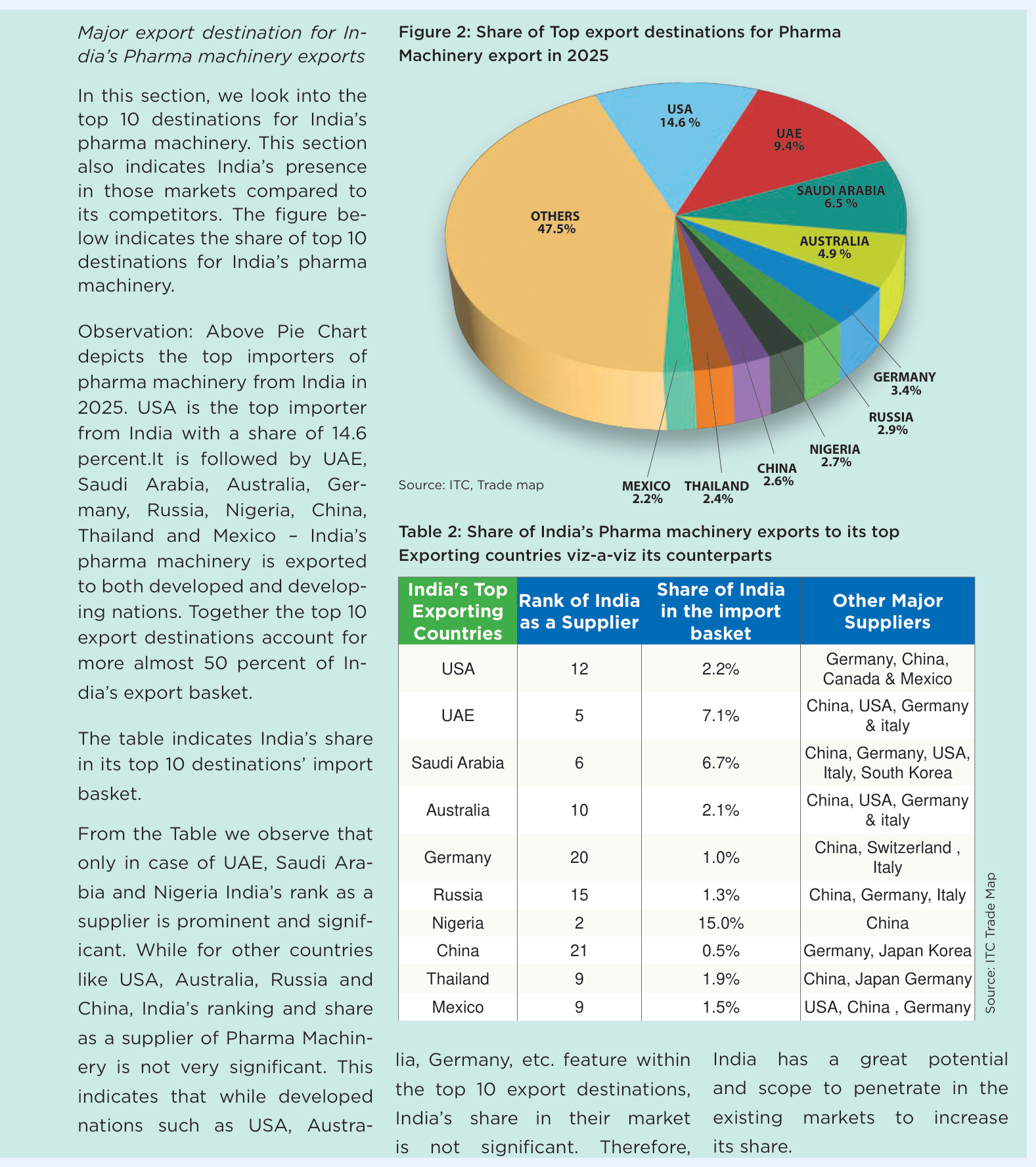
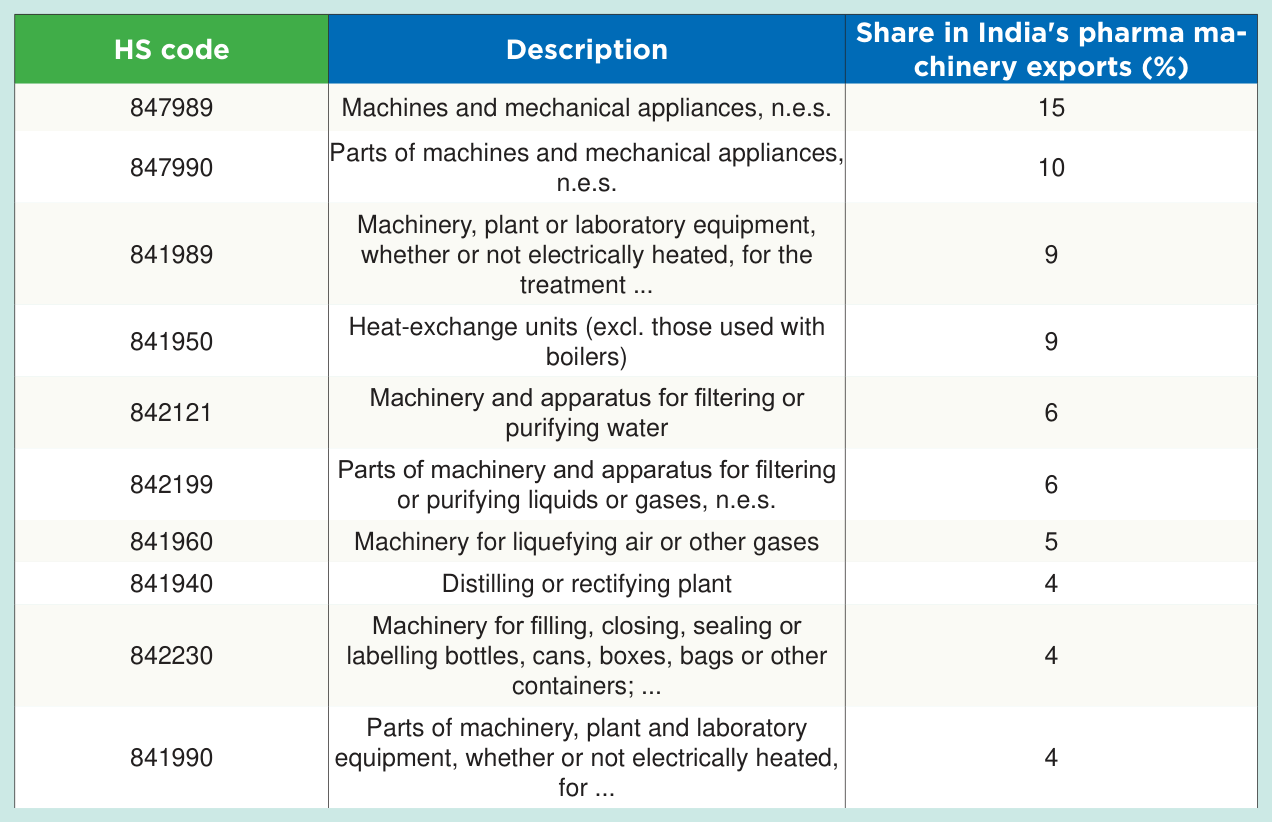
In the next table we have indicated the major pharma machinery items that are exported from India:
Figure 3: Top 10 exports from India in Pharma Machinery in FY 2025-26
Source: ITC Trade Map
The ten codes indicated in the above table indicates the top 10 exports from India in Pharma machinery. Together these ten codes contribute more than 70 percent of India’s pharma machinery exports. As is indicated from the table most of the products are low to medium value-added products. Therefore, India needs to go up the value chain to increase its share in global pharma machinery market.
Issues and Suggestions:
India’s pharmaceutical machinery sector has emerged as a critical enabler of the country’s “pharmacy of the world” status. However, despite these factors, India’s share in the global pharma machinery market remains modest, constrained by structural, technological, and policy-related challenges.

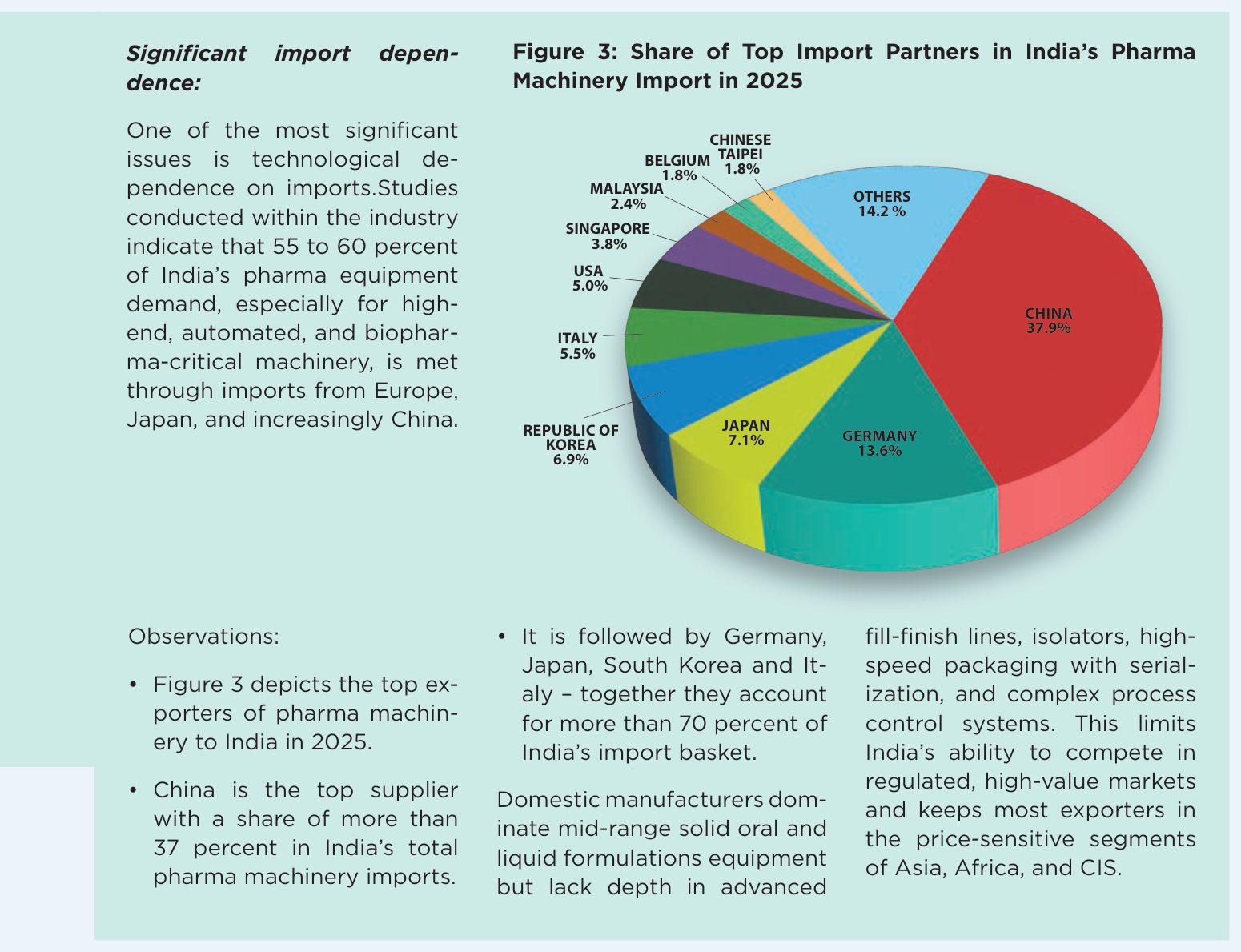
High Regulatory barriers
Compliance and regulatory barriers arealso significant factors in this industry. A Niti Aayog paper mention that global buyers, particularly in the US, EU, and other developed markets, now prioritize not only GMP compliance but also data integrity, ESG norms, and traceability across the supply chain. Indian MSMEs in the machinery space often struggle with the cost and complexity of meeting evolving GMP, validation (IQ/OQ/PQ), and documentation requirements, as well as country-specific product registrations and inspections. Non-tariff barriers, including Quality Control Orders (QCOs) and divergent standards, further raise compliance costs and delay market entry.
Limited Research and Development
Studies have also indicated that limited R&D and innovation intensity can be a major barrier for value upgradation. Compared to global leaders, Indian firms invest relatively less in advanced automation, Industry 4.0 integration, and next-generation equipment. This is compounded by fragmented industry structure, with many small players lacking scale to fund sustained R&D, global after-sales service networks, or brand-building in premium markets.
Market promotion and logistics:
The Niti Aayog paper also indicates that issues in logistics, financing, and inadequate export promotion focus specific to pharma machinery also pose challenges. While PLI schemes for pharmaceuticals, bulk drugs, and medical devices have strengthened domestic manufacturing, pharma machinery as a distinct capital goods segment may require equally targeted support for technology upgradation, testing/validation infrastructure, or export marketing.
Studies have indicated that a multi-pronged strategy is needed to enhance India’s pharma machinery exports. Some suggestions as indicated by Niti Aayog and other studies in this regard are listed below:
- Technology upgradation and R&D support: Extend PLI or similar incentive mechanisms to pharma machinery manufacturers for adopting advanced automation, digital twins, and GMP-by-design engineering. Establish common testing and validation centres for equipment qualification (IQ/OQ/PQ) to reduce compliance costs for MSMEs.
- • Regulatory harmonization and market access: Leverage FTAs (e.g., with EU, UK) to push for mutual recognition of GMP inspections, alignment of standards, and simplified product registration for Indian-made pharma equipment in partner countries. Create a dedicated export facilitation cell under DGFT/Pharmexcil for pharma machinery to guide firms on regulatory pathways in key markets.
- Cluster-based development and branding: Strengthen pharma machinery clusters in Gujarat, Maharashtra, and Himachal with shared R&D, skilling, and export infrastructure. Promote a “Made in India – GMP Compliant” brand for cost-effective, audit-ready equipment targeting emerging markets and mid-tier plants in regulated regions.
- Focus on high-growth segments: Prioritize capabilities in injectable fill-finish, lyophilization, containment systems, and advanced packaging to capture demand from biosimilars, vaccines, and complex generics, both domestically and in export markets.
With coordinated policy support, technology investment, and focused export promotion, India can transition from a midrange supplier to a globally competitive, value-added pharma machinery exporter.
Conclusion:
The growth of the pharmaceutical industry is likely to drive further developments in the Indian pharma machinery sector. As pharmaceutical companies expand, they will invest in modernizing their existing technologies and acquiring new machinery. The Indianpharma machinery industry is on a trajectory of sustained growth and global recognition. It continues to provide cutting-edge technology, superior quality, and responsive service to the pharmaceutical manufacturing sector, both domestically and internationally.
The outlook for Indian pharma machinery is optimistic. The sector’s growth is driven by a combination of factors, including increasing pharmaceutical production, quality consciousness, innovation, and government support. As the pharmaceutical industry continues to evolve and expand, Indian pharma machinery manufacturers are well-positioned to meet the rising demand, both domestically and internationally, while maintaining a focus on quality and compliance.
L I N K S
1. https://www.niti.gov.in/sites/default/files/2026-06/Trade-Watch-Quarterly-Jan-March-Q4-FY26.pdf
2. https://csep.org/working-paper/assessing-indias-trade-performance-pathways-to-strategic-and-deeper-integration-with-global-value-chains/ https://gccpl.com/blog/indias-pharma-exports-challenges-opportunities-2026/
3.https://www.pharmanow.live/pharma-manufacturing/pharma-machinery-and-equipment-significance-in-india
4.https://www.oemupdate.com/industry-report/the-indian-pharma-machinery-market-is-on-the-rise/
5.https://www.futuremarketinsights.com/reports/pharmaceuticals-machinery-market
6.https://economictimes.indiatimes.com/small-biz/trade/exports/insights/compliance-squeeze-global-scrutiny-redefine-indias-30-billion-pharma-export-playbook/ articleshow/130624508.cms

© Copyright , All rights reserved. Design by Andreal