







VOL. 19, ISSUE NO. 3 | June 2026

Tech Story





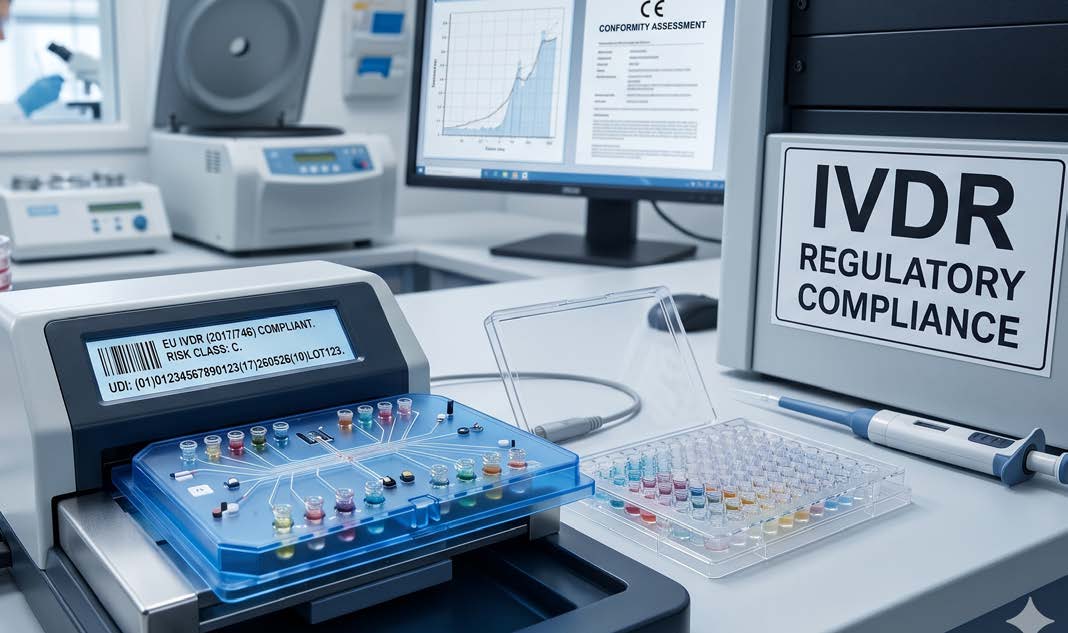
The EU (European Union )In Vitro Diagnostic Regulation (IVDR)-formally Regulation (EU) 2017/746-announced strict rules for exporting in vitro di-agnostic medical devices (IVDs) on the European market.
The EU Regulation (EU) 2017/746, the In Vitro Diagnostic Regulation (IVDR), sets out the legislative framework for placing in vitro di-agnostic medical devices on the EU market. Henceforth rigorous con-formity assessment for these devic-es must be conducted by a Notified Body (NB) to ensure the safety and e ectiveness of IVD devices sold in the EU.Based on the available literatures some of the fundamentals and the requirements of compliance obli-gations are discussed below.
What is IVDR?
The IVDR governs In Vitro Diagnos-tic Devices used for testing samples like blood or tissue to detect dis-eases, conditions, or infections (e.g.. COVID tests, genetic screening).
2 Key Changes from IVDD-IVDR It replaced the older directive Di-rective 98/79/EC and became ful-ly applicable on 26 May 2022, with transitional provisions IVDR is much stricter. Major shifts include:
i. Risk-based classification system Devices are classified into:
- Class A (low risk)
- Class B
- Class C
- Class D (highest risk, e.g., HIV tests)
ii. Stronger clinical evidence (per-formance evaluation) The Manufactures/Exporters must demonstrate:
- Scientific validity
- Analytical performance
- Clinical performance
iii. Unique Device Identification (UDI) Each device must have a trace-able identifier recorded in EU-DAMED. (European Database on Medical Devices)
iii. Unique Device Identification (UDI) Each device must have a trace-able identifier recorded in EU-DAMED. (European Database on Medical Devices)
3. Who Must Comply?
- Manufacturers (inside or out-side EU)
- Authorized Representatives (for non-EU companies)
- Importers Distributors Non-EU manufacturers must ap-point an EU-based authorized rep-resentative.
4. Core Compliance Obligations A. Quality Management System (QMS) One must implement a QMS (commonly aligned with ISO 13485).
B. Performance Evaluation A continuous process includ-ing:
- Performance evaluation plan
- Clinical evidence
- Performance evaluation report(PER)
C. Technical Documentation One must maintain detailed documentation covering:
One must maintain detailed documentation covering: Device description Risk management Manufacturing processes Performance data Labelling and instructions for use
D. Risk Management
Must be aligned with ISO 14971 (the international standard for risk management of medical devices). Identify hazards Estimate and control risks Monitor effectiveness
E. CE Marking
To sell in the EU, the device must carry the CE Mark, demonstrating IVDR compliance. For most devices: Certification by a Notified Body (e.g. SGS, BSI, DNV, etc.) is required. Conformity assessment route depends on device class.
F. Person Responsible for Regulatory Compliance (PRRC)
The exporter must designate a qualified PRRC responsible for: Regulatory compliance Documentation Post-market obligations
G. Post-Market Surveillance (PMS)
One must actively monitor device performance after its launch. PMS Plan Periodic Safety Update Reports (PSUR) (for Class C & D) Vigilance reporting (serious incidents)
H. Vigilance & Reporting
The requirement specifies reporting of: Serious incidents Field Safety Corrective Actions (FSCAs) within strict timelines to authorities via EUDAMED.
I. Supply Chain Traceability
Maintain traceability across the supply chain. Use UDI (Unique Device Identification) system. Maintain distribution records.
5. Conformity Assessment Routes
It depends on classification of the product: Class A (non-sterile): Self-declaration Class A (sterile) / B / C / D: Notified Body review Class D: Additional scrutiny (EU Reference Laboratories, Expert Panels)
6. Transitional Provisions (Important)
Devices previously certified under IVDD can remain on the market temporarily, subject to applicable deadlines (extended into 2027–2029, depending on device class).
7. Penalties for Non-Compliance
Market withdrawal Fines Legal liability Loss of CE certification
8. Compliance Roadmap
Classify the device Perform gap analysis against IVDR Implement QMS Generate performance evidence Prepare technical documentation Engage a Notified Body (if required) Register in EUDAMED Establish PMS and vigilance systems
Note
EUDAMED is the central IT system created by the European Union to support transparency, traceability, and regulatory oversight under both: Regulation (EU) 2017/746 (IVDR) Regulation (EU) 2017/745 (MDR)
Sources
A Step-by-Step Guide to EU IVDR Certification — SGS ISO 14971 — International standard for risk management of medical devices ISO 13485 — International standard specifying requirements for a Quality Management System (QMS) for medical device manufacturers

© Copyright , All rights reserved. Design by Andreal