







VOL. 19, ISSUE NO. 3 | June 2026

Focus





???? Image 2: focus_p23_img0.jpg
Replace REPLACE_WITH_CDN_URL_2
???? Image 3: focus_p23_img1.jpg
Replace REPLACE_WITH_CDN_URL_3
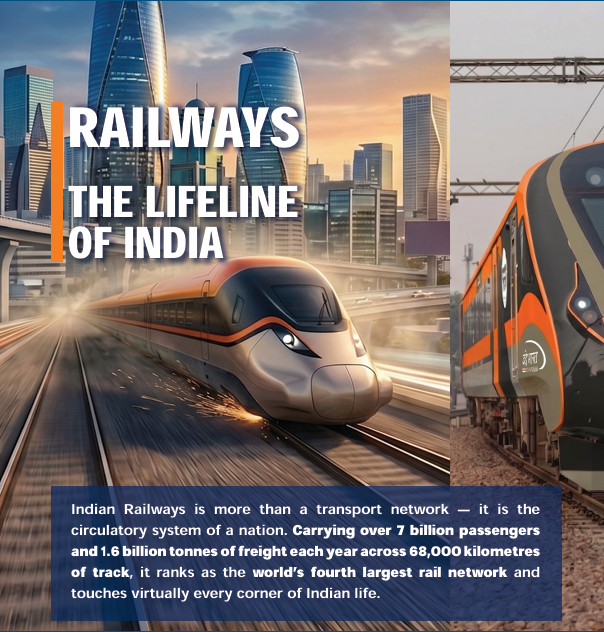
Today, it stands at the centre of something larger: India’s most ambitious infrastructure transformation in living memory. Electrifica‑ tion, station redevelopment, semi‑high‑ speed trains, metro expansions — the pace and scale of change are unlike any‑ thing the sector has seen before.
At the heart of this transformation is a quieter but equally consequential shift — the emergence of India as a global‑ ly competitive manufacturing hub for rolling stock, components, and metro rail systems. Strong domestic demand, a supportive policy environment, and an increasingly export‑oriented outlook are drawing manufacturers to India not merely as a market, but as a base.
This dynamic is shaped in part by a structural reality: Indian Railways oper‑ ates as a monopsony — the sole buyer of railway products and services in the country. Far from being a constraint, this concentration of demand is a powerful signal. It enables centralized planning, enforces standardization, and offers suppliers the kind of scale and predict‑ ability that is rare in global markets. For private manufacturers — domestic and foreign alike — winning a place in India’s railway supply chain means access to one of the world’s most consequential procurement pipelines, with the added advantage of a platform from which to serve markets beyond India’s borders.
???? Image 4: focus_p23_img2.jpg
Replace REPLACE_WITH_CDN_URL_4
Massive & Growing Passenger Base
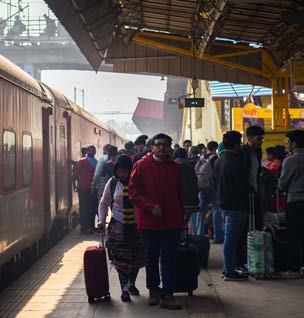
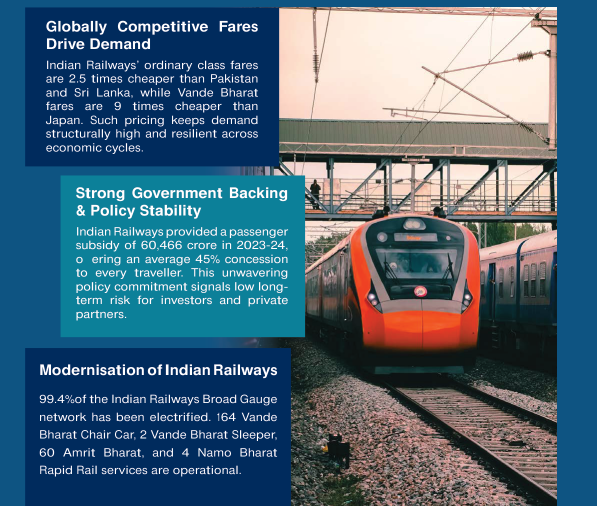
Indian Railways serves over 720 crore passengers annually, with ridership growing at ~6-8% year-on-year. This guaranteed, expanding market makes it one of the most stable investment ecosystems in the world.
Fleet Modernisation & Make in India
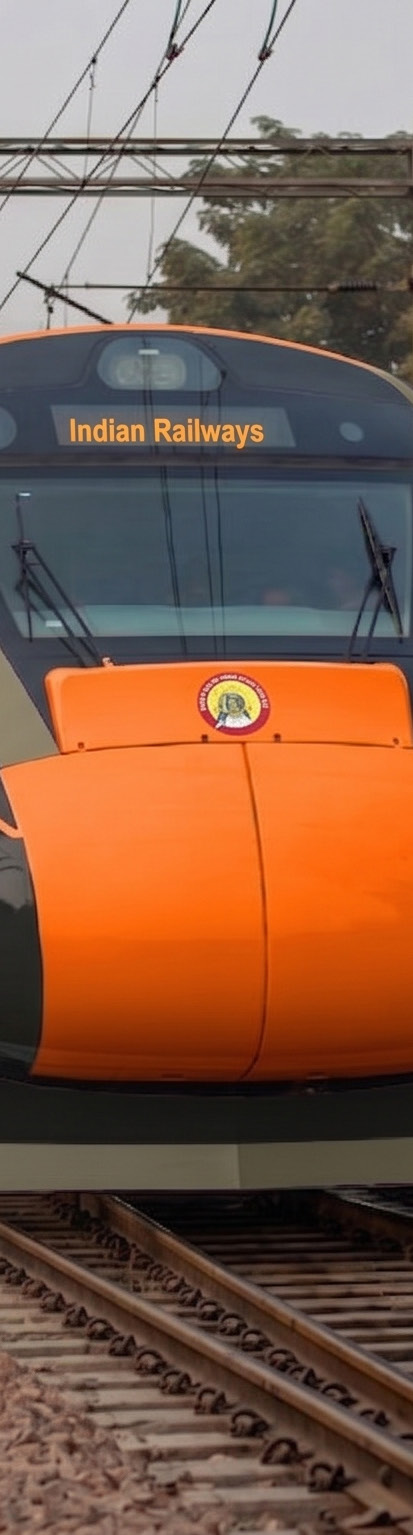
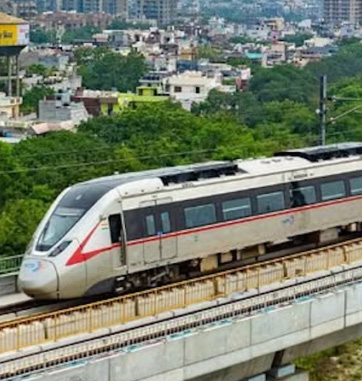
164 Vande Bharat, 54 Amrit Bharat, and 4 Namo Bharat Rapid Rail services are now operational, all indigenously designed and manufactured. This domestic production drive opens doors in electronics, rolling stock, and engineering sectors.
Advantage India
Growing Demand
The government announced 5,000km of Metro rail network by 2047 in 100 cities.Indian Railways continued to witness steady growth in passenger traffic and earnings in FY26. The total number of passengers carried increased to 741 crore in 2025–26 from 716 crore in 2024–25.
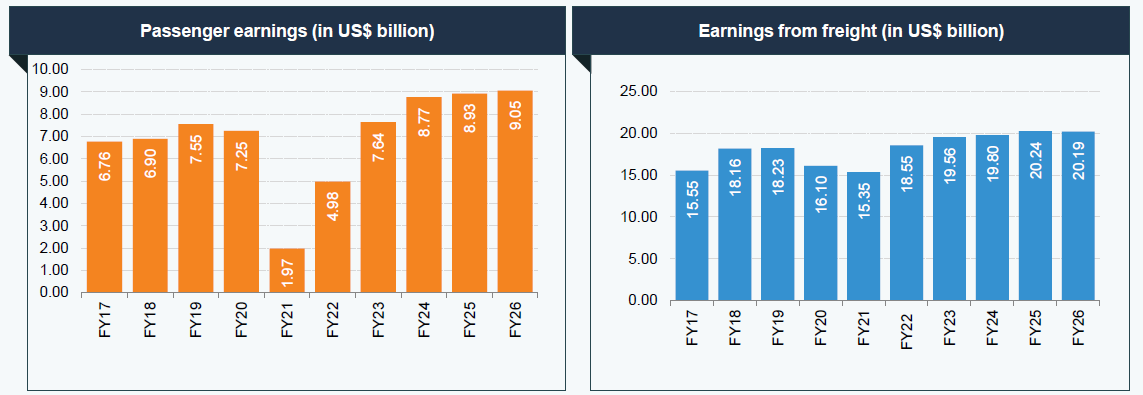
Passenger revenue increased by 5.96% to Rs. 800 billion (US$ 9.05 billion) in FY26 from Rs. 755 billion (US$ 8.93 billion) in FY25, support‑ ed by higher ridership and improved earnings across passenger services.
Opportunities
In FY2 3, One Station One Product scheme was launched to provide opportunities for enhanced live-lihood through skill development through provision of sale outlets at railway stations across India.
Indian Railways, as of 2025, has ex‑ panded 35,000 km of track, pro‑ duces 30,000 wagons and 1,500 locomotives annually, increased freight share to 29 %, cut accidents by 80 %, and plans 1,000 new trains and bullet train operations by 2027.
Higher Investment
Foreign Direct Investment (FDI) inflows in railway‑related components stood at Rs. 9,344 crore (US$ 1.44 billion) for April 2000‑ Decem‑ ber 2025. Rail infrastructure will see an investment of Rs. 50 lakh crore (US$ 715.41 billion) by 2030.
Revenue of Indian railway sector companies is expected to grow 5 % in FY26, with operating margins around 12 %, supported by govern‑ ment capital outlay of Rs. 2,52,000 crore (US$ 29.41 billion) and a strong order book‑to‑income ratio of 2.77.
Policy Support
From November 1, 2024, Indian Railways cut the advance reserva‑ tion period from 120 to 60 days.
Indian Railways launched the Rail‑ Tech Policy and portal to promote startup‑led technology adoption.They digitised the Railway Claims Tribunal, enabling online filing and hearings under the ‘52 Reforms in 52 Weeks” initiative.
Taking cognizance of its signifi‑ cance in overall infrastructural de‑ velopment, the NIP envisages an investment in Indian Railways worth Rs. 11.43 lakh crore (US$ 138 billion) till 2024‑25.
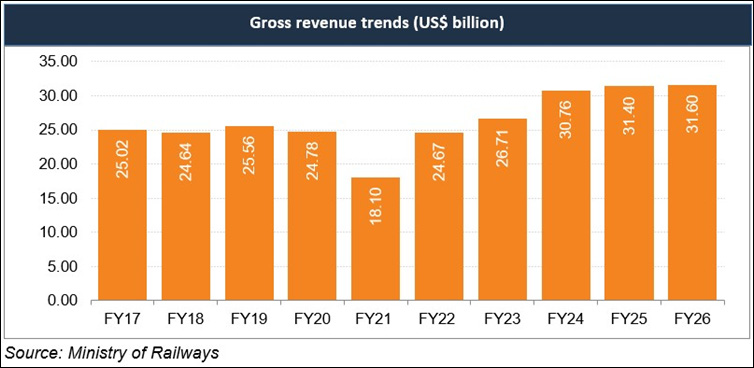
Indian Railways’ gross revenue stood at Rs. 2.79 trillion (US$ 31.57 billion) for FY26, reflecting the con‑ tinued strength of its freight‑led earnings model and steady growth in passenger revenues.Revenue of Indian railway sector companies is expected to grow 5 % in FY26, with operating margins around 12 %, supported by govern‑ ment capital outlay of Rs. 2,52,000 crore (US$ 29.41 billion) and a strong order book‑to‑income ratio of 2.77.
Foreign Direct Investment (FDI) inflows in railway‑related components stood at Rs. 9,344 crore (US$ 1.44 billion) for April 2000‑Decem‑ ber 2025.
As of April 1, 2025, Indian Railways has sanctioned 431 infrastructure projects, including 154 New Line, 33 Gauge Conversion and 244 Doubling, covering 35,966 km at an estimated cost of Rs. 6,75,000 crore (US$ 78.41 billion). Out of this, 12,769 km has been commis‑ sioned, with an expenditure of ap‑ proximately Rs. 2,91,000 crore (US$ 33.65 billion) up to March 2025.
Indian Railways plans to invest Rs.16,70,000 crore (US$ 193.98 bil‑ lion) by 2031 to modernise 1,309 stations, expand freight corridors, develop high‑speed rail projects, and electrify tracks, aiming to boost operational efficiency and reduce logistics costs.
India’s export of railways grew at and reached US$ 315 million in FY24 as compared to US$ 173 mil‑ lion in FY21.
Since 2016, Indian Railways has ex‑ ported over 1,000 rail cars, 3,800 bogies, 4,000 flatpacks, and 5,000 propulsion systems to countries in‑ cluding Australia, Canada, Germany, Egypt, Sweden, Brazil, the UK, Sau‑ di Arabia, France, Mexico, Romania, Spain, Italy, Mozambique, Senegal, Sri Lanka, Myanmar, Bangladesh, and the Republic of Guinea, reflect‑ ing rapid growth in global exports up to 2025.
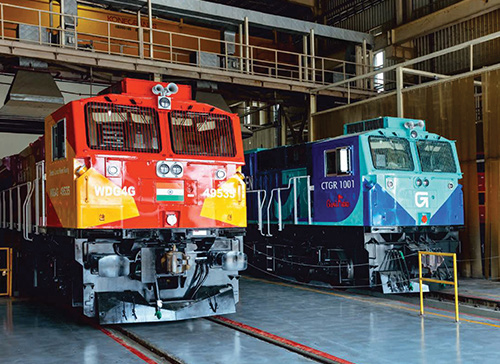
The Marhowrah Diesel Locomotive Factory in Bihar will export 150 Evo‑ lution Series ES43ACmi locomo‑ tives to Guinea’s Simandou iron ore project under “Make in In‑ dia,” in a Rs. 3,000 crore (US$ 345.9 million) deal, boosting India’s global railway exports with ad‑ vanced 4,500 HP loco‑ motives and creating over 2,100 jobs nationwide.
Under the Union Budget 2026–27, Indian Railways has been allocated a re‑ cord capital expenditure of Rs. 2,93,030 crore (US$ 32.56 billion), underscor‑ ing the government’s continued focus on mod‑ ernising rail infrastructure, expanding network capacity, and strengthen‑ ing freight and passenger connectivity.
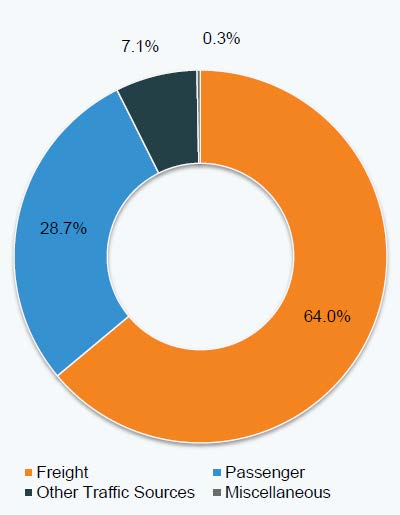
REVENUE BREAKDOWN BY SEGMENT (FY26)
The Union Budget 2026 proposed seven new high‑speed rail corridors including Mumbai–Pune, Hyderabad–Bengaluru, Chennai–Bengaluru, Delhi–Varanasi and Varanasi– Siliguri—to accelerate high‑speed connectivity across major econom‑ ic regions.
India is expanding its railway manu‑ facturing footprint globally, export‑ ing coaches, bogies, locomotives, and propulsion systems to more than 16 countries, supported by ris‑ ing orders and successful deliveries from facilities such as the Marhowra plant.
The total number of passengers carried increased to 741 crore in 2025–26 from 716 crore in 2024–25.
164 Vande Bharat trains are opera‑ tional as of December 2025.
Indian Railways will launch the first Vande Bharat Sleeper train in September 2025, offering speeds up to 180 kmph. With features like USB charging, modular pantries, enhanced safety, and showers in 1st AC coaches, it aims to redefine long‑distance rail travel.
SEGMENT-WISE REVENUE GROWTH FOR INDIAN RAILWAYS
As of March 2025, Indian Railways operates more than 13,000 pas‑ senger trains, including 4,111 Mail and Express trains, 3,313 Passenger trains, and 5,774 Suburban trains.
In FY26 (Revised Estimates), freight revenue rose to Rs. 1.78 trillion (US$ 20.11 billion), accounting for 63.97% of Indian Railways’ total receipts, reaffirming freight as the primary revenue driver for the sector.
In February 2026, Indian Railways reported freight earnings of Rs.145.72 billion (US$ 1.65 billion), with freight loading rising 3.96% YoY to 137.72 million tonnes, driven by strong growth in steel, iron ore and fertiliser traffic.
In FY26, Indian Railways carried a record 1,670 million tonnes (MT) of freight, registering a 3.25% increase over the previous year, reflecting sustained growth in rail‑based lo‑ gistics demand.
India’s freight wagon market is ex‑ pected to nearly double by 2031, rising to about Rs. 25,000 crore to Rs. 30,000 crore (US$ 2.83 billion to US$ 3.40 billion), driven by ex‑ ports, technology upgrades and large‑scale procurement.
In FY26, passenger revenue in‑ creased to Rs. 800 billion (US$ 9.05 billion) from Rs. 755 billion (US$ 8.93 billion) in FY25, supported by higher ridership and improved earn‑ ings.
Passenger traffic increased to 7.41 billion in FY26 from 7.16 billion in FY25, reflecting sustained growth in rail‑based mobility across the country.
In FY26, Indian Railways loaded a record 1,670 MT of freight, while freight earnings rose to Rs. 1.78 tril‑ lion (US$ 20.11 billion), driven by strong growth in fertilisers, steel, iron ore, and cement movement.
Indian Railways has boosted op‑ erational efficiency by modernis‑ ing trains and stations, improving punctuality to 80% in FY26, de‑ ploying advanced Vande Bharat, Amrit Bharat, and Namo Bharat ser‑ vices, upgrading tracks and signal‑ ing, expanding bio‑toilet coverage, and streamlining catering, all while maintaining affordable fares for over 720 crore passengers.
Indian Railways is developing and creating technology in areas such as signalling and telecommunica‑ tion with 15,000 km being convert‑ ed into automatic signalling and 37,000 km to be fitted with ‘KA‑ VACH’, the domestically developed Train Collision Avoidance System.
The Road Ahead
Indian Railways is poised for sus‑ tained long‑term growth, supported by a record capital expenditure allo‑ cation of Rs. 2.93 trillion (US$ 32.56 billion) in Union Budget 2026–27 and continued investments in net‑ work expansion, safety, and high‑ speed connectivity. Ongoing initia‑ tives such as multitracking projects, station redevelopment under the Amrit Bharat Station Scheme, 100% electrification efforts, and capacity augmentation through dedicated freight corridors are expected to significantly enhance operational efficiency, reduce logistics costs, and improve passenger experience.The continued rollout of Vande Bharat sleeper trainsets and prog‑ ress on the Mumbai–Ahmedabad Bullet Train project further rein‑ force the sector’s transition towards modern, technology‑driven rail in‑ frastructure.
Going forward, strong momentum in freight loading, premium pas‑ senger services, and green mobili‑ ty initiatives is expected to support revenue growth and strengthen Railways’ role as the backbone of India’s transport and logistics eco‑ system. Rising investments in dig‑ italisation, AI‑led safety systems, startup‑led innovation, and inte‑ grated cargo terminals under the PM Gati Shakti framework are like‑ ly to improve service reliability and network efficiency. With sustained policy support and infrastructure modernisation, Indian Railways is well‑positioned to drive economic growth, support industrial supply chains, and advance India’s vision of a globally competitive and sus‑ tainable transport network.
References: Press Releases, Department of Industrial Policy and Promotion, Press Information Bureau, Media Reports, Railways Budget 2026-27, Indian Railways
INDIA Pavilion at Africa Rail 2026
Meanwhile, EEPC India is also coor‑ dinating the India Pavilion at Africa Rail being held over July 7 and 8, 2026 in Johannesburg, South Africa
Africa Rail is the largest and lon‑ gest‑running rail industry trade ex‑ hibition and conference in Africa.It brings together rail operators, government officials, investors,technology suppliers, infrastructure developers, and industry pro‑ fessionals to share insights, show‑ case solutions, and build strategic partnerships. The event focuses on investment, innovation, and devel‑ opment across Africa’s rail, freight, and transport sectors. A world‑class experience for innovators across the entire rail and transport indus‑ try, Africa Rail is more than just an event, it’s a catalyst for the growth and development of the entire Afri‑ can railway industry.
The focus product of this exhibi‑ tion is mainly comprised of ‘Railway Transport Equipment and parts’ where India’s exports to South Af‑ rica is mere USD 3 million. However, India’s export is significant in relat‑ ed segments like Industrial machin‑ ery, Electric machinery, Construc‑ tion machinery and Aircrafts etc.This exhibition therefore will be a good opportunity for the export‑ ers to enhance exports of Railway transport equipment as Indian engi‑ neering products has already creat‑ ed a Brand Value is South Africa.
Opportunity in engineering industry of South Africa
South Africa is the largest economy of Africa and is an emerging one. It has a strong industrial base and it witnesses considerable progresses in infrastructural development, en‑ ergy sector and industrial sectors like agricultural, mechanical, civil and IT engineering. As infrastruc‑ ture development is a priority for the government and energy crisis is a challenge for the economy, the scope in several areas of engineer‑ ing is substantial, especially when the market is driven by private in‑ vestments. Trade exhibitions on en‑ gineering on South African soil will surely bring considerable opportu‑ nities for Indian engineering manu‑ facturers and exporters to enter as well as expand their businesses in that country.
Bilateral Trade between India and South Africa
India’s bilateral trade with South Africa reached an all‑time high of USD 19.2 billion in 2023‑24 but then declined to USD 18 billion due to drop in India’s exports. India’s merchandise exports to the larg‑ est African economy witnessed significant growth at 17.4% CAGR between 2020‑21 and 2024‑25. Ex‑ ports reached a high of USD 8.71 billion in 2023‑24 but then declined to USD 7.46 billion in the next fiscal due to decline in exports of Miner‑ al Fuels. Engineering exports also recorded good growth during the last five fiscals to 2024‑25 with a CAGR of 12.2% and reached USD 2.5 billion in fiscal 2024‑25. During the first nine months of 2025‑26, engineering exports to South Africa secured 15.7% year‑on‑year growth.India’s major engineering exports to South Africa include Motor vehicle/ cars, Other construction machinery, Industrial machinery, Auto com‑ ponents/parts, Electric machinery and equipment, Aluminium and its products, and Auto tyres and tubes among others.
© Copyright , All rights reserved. Design by Andreal