







VOL. 18, ISSUE NO. 12 | March 2026

Focus





India’s power sector continues to see rapid growth in renewable energy. India added 29.52 GW of renewable capacity in FY25, and a record 20.10 GW of renewable energy capacity in April‑August FY26, a 123% increase YoY, taking total Renewable Energy to 250.64 GW (excluding 8.78 GW of Nuclear capacity) as of October 2025, and moving firmly toward the 500 GW non‑fossil 2030 goal. By the end of October 2025, solar energy contrib‑ uted 129.9 GW, wind 53.60 GW, bio‑ mass 10.76 GW, small hydropower 5.16 GW, waste‑to‑energy 0.86 GW, and hydropower 50.35 GW. Nucle‑ ar power capacity stood at 8.8 GW.India recorded its highest renew‑ able energy share as renewables met 51.5% of the country’s 203 GW electricity demand in July 2025, up from 6% in FY15.
Power is one of the most criti‑ cal components of infrastructure, playing a central role in econom‑ ic growth and social development.For India, building and maintaining adequate power infrastructure has been vital to sustaining high growth and improving quality of life. India’s power sector is among the most di‑ versified in the world, drawing from conventional sources such as coal, lignite, natural gas, oil, hydro, and nuclear power, as well as non‑con‑ ventional sources including wind, solar, and biomass. Rapidly rising electricity demand continues to drive capacity expansion, making large‑scale additions to generation capacity essential for the future.
- India’s Nuclear Energy Mission sets a target of achieving 100 GW of nuclear power capacity by 2047.
- Renewable growth has been matched by record investments.
- In June 2025, capacity surged 420% YoY, led by solar at 117 GW and wind at 51.7 GW, supported by Rs. 84,309 crore (US$ 9.8 bil‑ lion) of investments in Q1 2025.
- Financing support is also ex‑ panding, with bank loans to re‑ newable energy under Priority Sector Lending
(PSL) reaching Rs. 7,558 crore (US$ 874.1 million) in April 2024‑Janu‑ ary 2025, prompting proposals for a dedicated sub‑target for green projects.
Thermal power continues to play a dominant role. India had 219 GW of installed coal capacity as of Octo‑ ber 2025, supported by record coal production of 1,047.68 MT. Pow‑ er shortages fell sharply to 0.1% in FY25 from 4.2% in FY14, under‑ scoring improved supply reliability.
Thermal plant load factors are ex‑ pected to improve to 63% in FY24, driven by strong demand growth and limited new capacity addition.
The investment outlook for the sector remains robust. Ac‑ cording to Motilal Oswal, the Indian power sector offers an invest‑ ment opportunity of Rs. 40,00,000 crore (US$ 461.95 billion) over the next decade, driven by rising de‑ mand, infrastructure upgrades, and a transition toward clean energy.
Developments in India’s Power Sector

Power is one of the key sectors at‑ tracting FDI inflow into India, and it accounted for about 2.65% of the total FDI inflow until June 2025.From April 2000‑June 2025, In‑ dia recorded FDI inflow worth Rs.1,69,772.12 crore (US$ 23.05 billion) in the non‑conventional energy sec‑ tor. Total FDI inflows in the power sector reached Rs. 1,21,734.99 crore (US$ 19.8 billion) between April 2000‑June 2025, accounting for 2.7% of the total FDI, underscoring strong investor confidence and the sector’s long‑term growth poten‑ tial.
- Multiple drivers (industrial ex‑ pansion, growing per capita in‑ comes) are leading to growth in power demand .This is set to con‑ tinue in the coming years.
- India is set to become a global manufacturing hub with invest‑ ment across the value chain.
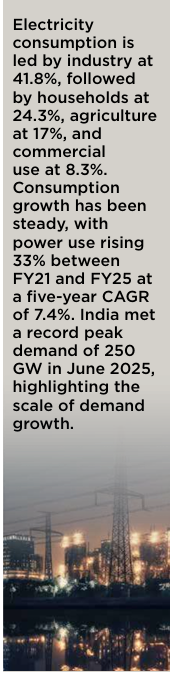
- The Central Electricity Authority (estimates India’s power require‑ ment to grow to reach 817 GW by 2030.
- In the current decade 2020 2029 the Indian electricity sector is likely to witness a major transfor‑ mation with respect to demand growth, energy mix and market operations.
- Demand for electricity is expect‑ ed to increase per capita con‑ sumption of electricity is estimat‑ ed to stand at 1 824 kWh by FY 27 from 1 538 kWh in FY 25.
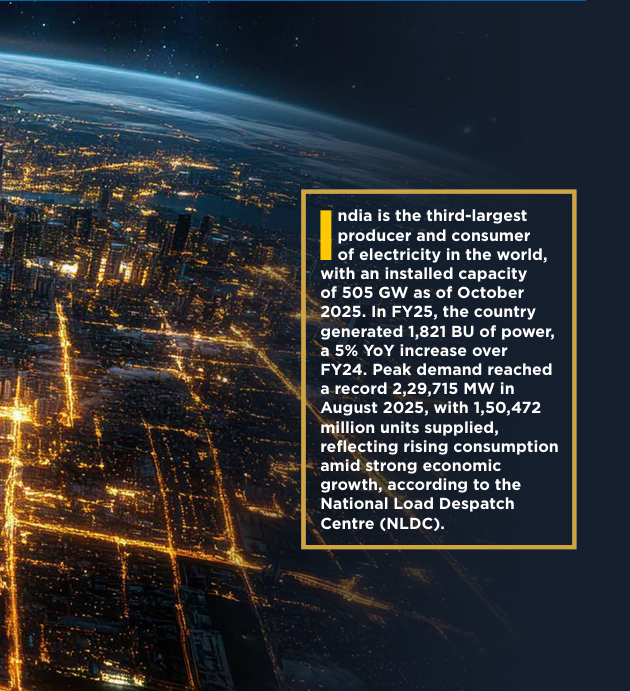
- India is the third largest produc‑ er and consumer of electricity worldwide, with an installed power capacity of 476 GW as of June 2025. Although power generation has grown more than 100‑fold since independence, growth in demand has been even higher due to accelerating eco‑ nomic activity.
- India ranks fourth globally in Re‑ newable Energy Installed Capac‑ ity, fourth in Wind Power, and third in Solar Power capacity, as of 2025. It is also the only G20 nation on track to meet its Paris Agreement targets.
- India has been on a path to achieve 100 household elec‑ trification as envisaged under the Saubhagya scheme. As of March 2023 more than 2.86 crore households were electrified un‑ der the Saubhagya scheme.
- A total of 235.7 GW of genera‑ tion capacity from non fossil fuel sources has been installed in the country as of June 2025.
- Robust Growth In Renewables
- The PM Surya Ghar Muft Bijli Yo‑ jana aims to provide free roof‑ top solar electricity to one crore households by March 2027 add‑ ing 30 GW capacity, saving the government Rs 75, 000 crore (US 8.71 billion) and creating 17 lakh jobs.
- India has unveiled a comprehen‑ sive plan worth Rs. 9.15 lakh crore (US$109.50 billion)to enhance its power infrastructure and meet a projected demand of 458 GW by 2032.This initiative, led by the Ministry of Power under Prime Minister Mr.Narendra Modi, aims to strengthen the national power grid and boost energy security.
- As per the Central Electricity Au‑ thority (CEA) estimates, by 2029 30 the share of renewable energy generation would increase from 18% to 44% while that of thermal is expected to reduce from 78% to 52%.
- India has a net nuclear energy in‑ stalled capacity of 8.8 GW as of June 2025. India’s nuclear sourc‑ es are expected to contribute nearly 9% of the electricity share by 2047. The Department of Atomic Energy is targeting a nu‑ clear power generation capacity of 20 GW by 2030, positioning India as the world’s third largest producer of atomic energy, fol‑ lowing the USA and France.
- India is advancing its nuclear energy sector by allowing pri‑ vate and foreign firms to partic‑ ipate, aiming to expand capacity twelvefold by 2047 and strength‑ en energy security.
Major investments in the Indian power sector
India and Canada are nearing a Rs. 24,982 crore (US$ 2.8 billion), 10‑ year uranium‑supply agreement un‑ der which Canada’s Cameco Corp.would provide uranium fuel to sup‑ port India’s expanding nuclear pow‑ er programme.
On October 30, 2025, India and Ne‑ pal agreed to develop two new 400 kV cross‑border transmission lines, connecting Inaruwa to New Purnea and Lamki (Dodhara) to Bareilly, to strengthen electricity trade and re‑ gional grid integration.
India aims to cut green hydrogen costs from Rs. 401.60 (US$ 4.50) per kg to Rs. 89.24 (US$ 1) per kg by 2030, according to former NITI Aayog CEO Mr. Amitabh Kant.
India plans to double capex to Rs.72,72,600 crore (US$ 850 billion) by 2030, with Rs. 25,66,800 crore (US$ 300 billion) directed to power and transmission, led by NTPC, Tata Power, and Power Grid Corporation.
The International Solar Alliance (ISA), launched by India and France at the 21st Conference of the Par‑ ties (COP21) in 2015, the ISA of 100+ countries aims to mobilise Rs.86,09,000 crore (US$ 1 trillion) by 2030. It aims cut solar costs, and promote affordable clean ener‑ gy, especially for Least Developed Countries (LDCs) and Small Island Developing States (SIDS).
India’s thermal power sector is set to attract Rs. 2,30,000 crore (US$ 26.71 billion) in investments by 2027‑28, with private players con‑ tributing around one‑third, sup‑ porting the addition of 80 GW capacity by 2031‑32 and ensuring stable base load energy alongside renewable growth.
India’s energy storage sector is poised to attract an investment of Rs. 4,79,000 crore (US$ 56.07 bil‑ lion) by 2032, as per the India Ener‑ gy Storage Alliance (IESA).
Adani Group will invest US$ 60 bil‑ lion in power by FY32 to build 50 GW renewable capacity, expand transmission to 30,000 km, and strengthen coal‑based baseload to support India’s 1,000 GW capacity target.On September 6, 2025, Adani Power has signed an agreement with Bhutan’s Druk Green Power to de‑ velop the 570 MW Wangchhu hy‑ droelectric project with Rs. 6,000 crore (US$ 700.2 million) invest‑ ment, marking the first project un‑ der their 5,000 MW hydropower partnership.
Hindustan Power has signed a 25‑ year Power Purchase Agreement (PPA) with Uttar Pradesh Power Corporation Limited (UPPCL) for a 435 MW Direct Current (DC) so‑ lar project, supporting the state’s 22,000 MW clean energy goal by FY27 and boosting private sector participation in renewable growth.
Tata Power, with 43% of its portfolio in green energy, plans to invest 60% of its Rs. 1,46,000 crore (US$ 16.96 billion) capex to expand renewable capacity to 23 GW by FY30, sup‑ porting India’s 500 GW non‑fossil fuel target.
On August 21, 2025, PFC signed a US$ 175.78 million loan agreement with Germany’s KfW, to fund projects under the Revamped Distri‑ bution Sector Scheme (RDSS) and strengthen India’s power distribu‑ tion sector.

In July 2025, NHPC Ltd signed a MoU with IIM Jammu to drive lead‑ ership development, capacity build‑ ing, and research collaboration. The partnership will deliver executive training, joint case studies, and knowledge‑sharing platforms to build a future‑ready workforce.
On July 27, 2025, NHPC Ltd and Indian Oil Corporation Ltd (IOCL) signed an MoU to jointly develop pumped storage, hydroelectric, and renewable energy projects in India and overseas, aimed at accelerat‑ ing clean energy expansion and strengthening their renewable port‑ folios.
Avaada Group announced on April 29, 2025, that it has signed an ini‑ tial agreement with the Maharash‑ tra government to develop two pumped storage projects in the state, with a combined capacity of 3,600 megawatts (MW). The proj‑ ects, which include the 2,400 MW Pawana Falyan and the 1,200 MW Sirsala, will require a cumulative in‑ vestment of Rs. 15,100 crore (US$ 1.77 billion).
On April 21, 2025, DVC and Coal India Ltd signed an MoU to devel‑ op a Rs. 16,500 crore (US$ 1.92 bil‑ lion) 2x800 MW ultra‑supercritical coal power plant at Chandrapura and explore additional thermal and green energy projects.
On April 21, 2025, Prime Minister Mr. Narendra Modi inaugurated the first 660 MW unit of the 1,320 MW Buxar Thermal Power Project by SJVN, a Rs. 13,757 crore (US$ 1.6 billion) in‑ vestment to enhance power supply in Bihar and the Eastern Region.
India has achieved a historic mile‑ stone, surpassing one billion tonnes of coal production in FY24, reinforc‑ ing its commitment to energy secu‑ rity and self‑reliance. The country produced 997.83 million tonnes of coal during the fiscal year, marking a significant step towards reducing import dependence and strength‑ ening domestic energy supply.
Bharat Heavy Electricals Limited (BHEL) and Hitachi Energy India have secured a contract from Adani Energy Solutions to develop India’s largest private power transmission project, valued at Rs. 12,000 crore (US$ 1.41 billion). The project aims to establish high‑voltage direct cur‑ rent (HVDC) terminals to facilitate power transmission from Bhadla, Rajasthan, a major renewable ener‑ gy hub, to Fatehpur, Uttar Pradesh.
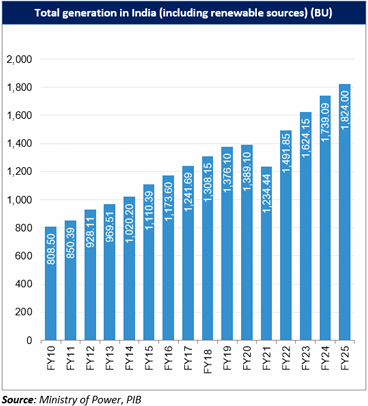
In FY25, the power generation in In‑ dia was 1,821 BU, representing a 5% year‑on‑year growth over the 1,734 BU generated in FY24
On December 13, 2024, PGCIL and ONGC signed an MoU to collabo‑ rate on green hydrogen and clean energy projects, leveraging their strengths to explore new business opportunities and support India’s energy transition.
In 2023‑24, India’s renewable ener‑ gy sector received Rs. 32,141 crore (US$ 3.7 billion) in foreign invest‑ ment.
India has received a cumulative amount of US$ 3.8 billion in foreign direct investment (FDI) in the solar energy sector over the past three fiscal years and the ongoing fiscal year until September 2023.
The power generation industry in India will require a total investment of Rs. 33 lakh crore (US$ 400 bil‑ lion) and 3.78 million power profes‑ sionals by 2032 to meet the rising energy demands, as per the Nation‑ al Electricity Plan 2022‑32.
GOVERNMENT POLICIES & INITIATIVES FOR INDIA’S POWER SECTOR T
The Government of India has identified the power sector as a key sector of focus to pro‑ mote sustained industrial growth.Some initiatives by the Government to boost the Indian power sector are as below:
PM Surya Ghar scheme is expected to save the government Rs. 75,000 crore (US$ 8.60 billion) annually in electricity costs, add 30 GW of so‑ lar capacity, generate 1,000 billion units over 25 years, and reduce CO2 emissions by 720 million tonnes.
The government aims to power one crore homes by FY27. Gujarat leads with 3.51 lakh solar‑powered households (18.14%), followed by Maharashtra (1.92 lakh, 22.79%), Ut‑ tar Pradesh (75,602, 8.69%), Kera‑ la (65,423, 7.73%), and Rajasthan (26,622, 3.14%).
India has unveiled a comprehensive plan worth Rs. 9.15 lakh crore (US$ 109.50 billion) to enhance its power infrastructure and meet a project‑ ed demand of 458 GW by 2032.This initiative, led by the Ministry of Power under Hon’ble Prime Minister of India, Mr. Narendra Modi, aims to strengthen the national power grid and boost energy security. The Gov‑ ernment of India has approved new Inter State Transmission System (ISTS) schemes to evacuate 9 GW of RE power from Rajasthan and Karnataka. These schemes will be implemented through Tariff Based Competitive Bidding (TBCB) mode.These schemes are part of 500 GW RE capacity by 2030 out of which 200 GW is already connected.
The government launched a Rs.5,400 crore (US$ 627.3 million) Vi‑ ability Gap Funding scheme for 30 GWh Battery Energy Storage Sys‑ tems and extended the Inter‑State Transmission System waiver for storage projects till June 30, 2028.
The PLI Scheme for High Efficien‑ cy Solar Photovoltaic (PV) Mod‑ ules, with an outlay of Rs. 24,000 crore (US$ 2.78 billion) has enabled 48,337 MW of capacities, with 17 GW of modules, 6 GW of cells, and 2 GW of ingot‑wafer manufacturing operational as of March 31, 2025.
India may introduce a PLI‑like scheme to boost domestic trans‑ mission equipment and renewable energy evacuation, with 190,000 ckm lines and 1,270 GVA capac‑ ity planned, attracting over Rs.9,00,000 crore (US$ 104.54 billion) investment by 2035.
As of January 2025, the UJALA and SLNP schemes have collectively distributed over 38 crore LED lights, saving Rs. 19,153 crore (US$ 2.22 billion) annually, cutting 3.87 crore tonnes of CO₂, and significantly boosting India’s energy efficiency.
The Union government has ap‑ proved Rs 8,146 crore (US$ 946.2 million) Tato‑II Hydro‑Electric Proj‑ ect in Arunachal Pradesh, adding 700 MW capacity, 12% free power to the state, and boosting local in‑ frastructure, employment, and so‑ cio‑economic development.
The Union Cabinet has sanctioned the PM‑Surya Ghar: Muft Bijli Yojana.This initiative, with a total budget of Rs. 75,021 crore (US$ 9 billion) aims to install rooftop solar systems and offer complimentary electricity of up to 300 units per month to one crore households.
The Union Budget 2025‑26 marks the launch of a Nuclear Energy Mis‑ sion, which focuses on the research and development (R&D) of Small Modular Reactors (SMRs). The gov‑ ernment has allocated Rs. 20,000 crore (US$ 2.33 billion) for this ini‑ tiative, with the aim of developing at least five indigenously designed and operational SMRs by 2033.
The Union Budget 2025‑26 outlines a strategy for the development of Bharat Small Reactors (BSRs), which are designed to reduce land requirements and support indus‑ tries in decarbonization efforts. Un‑ der this plan, private sector entities will provide land, cooling water, and capital, while the Nuclear Power Corporation of India Limited (NP‑ CIL) will be responsible for the de‑ sign, quality assurance, operation, and maintenance of the reactors.
In the Union Budget 2025‑26, the government boosted its flagship rooftop solar initiative, PM Surya Ghar: Muft Bijli Yojana, by allocating Rs. 20,000 crore (US$ 2.33 billion) an 80% increase to fast‑track the deployment of rooftop solar proj‑ ects.
In the Budget for 2024, the govern‑ ment’s power sector initiatives have been allocated funds that are 50% higher. Increased funds have been allocated to green hydrogen, solar power, and green‑energy corridors in line with the renewable energy target for 2030.

The Indian power sector is poised for a major transfor‑ mation in the current decade (2020‑29), shaped by rising de‑ mand, a changing energy mix, and evolving market operations. The country’s vision is to provide reliable electricity access to all while accel‑ erating the clean energy transition by reducing dependence on fossil fuels and expanding renewable energy adoption. Strong demand fundamentals, supportive policies, and increasing government focus on infrastructure are expected to drive future investments. According to the Central Electricity Authority (CEA), India’s power requirement is projected to reach 817 GW by 2030.By 2029‑30, the share of renewable energy in power generation is ex‑ pected to rise sharply from 18% to 44%, while thermal energy’s share is likely to decline from 78% to 52%. In line with this vision, the govern‑ ment has set a target of installing 500 GW of renewable energy ca‑ pacity by 2030, positioning India as a global leader in clean energy.

© Copyright , All rights reserved. Design by Andreal