







VOL. 18, ISSUE NO. 12 | March 2026

Spotlight





Where local capabilities connect with global vision to shape a secure, sustainable and resilient electricity future
Bharat Electricity Summit 2026 is India’s premier platform for the power and electricity sec‑ tor. Held under the patronage of India’s Ministry of Power, the event is scheduled to take place from 19‑22 March 2026 at Yashobhoomi, Dwarka, New Delhi.
Convening global policymakers, CEOs, government leaders, electricity experts, investors, regulators, innovators, suppli‑ ers and solution providers, all commit‑ ted to driving progress across the entire electricity value chain, from generation and transmission to distribution, storage and smart consumption.
Showcasing India’s leadership, scale and innovation in renewables, storage and power infrastructure, the event under‑ scores the nation’s growing role in deliv‑ ering solutions with global impact.

Rising peak demand, growing variable renewable energy (RE) generation, and operational hurdles are presenting unprecedented challenges for Indian DISCOMs. Between late May and De‑ cember 2025, the country was forced to curtail 2.3 TWh of solar generation due to rising solar generation and weak‑ er‑than‑forecast demand. 0.9 TWh was curtailed in October alone—nearly 7% of average monthly solar generation.Under the emergency Tertiary Reserve Ancillary Service (TRAS) provisions, so‑ lar generators received ₹575‑690Cr despite curtailment, resulting in economic and environmental losses to the power system. At the same time, procuring power during non‑solar hours is becom‑ ing costlier due to rising peak demand, particularly in the late evenings. In May 2024, for example, extreme nighttime peaks nearing 220 GW—90th percentile of India’s all‑time high of 250 GW—and poor wind conditions resulted in minimal RE generation, forcing DISCOMs to rely on gas generators that are 1.5‑3x more expensive than coal. These complexi‑ ties underscore the need for distribut‑ ed energy storage solutions that can help DISCOMs store excess RE for use during peak demand. Ultimately, distrib‑ uted energy storage can save DISCOMs power procurement costs, enhance grid flexibility and integrate more RE, and optimise distribution network operation.
India stands at a pivotal moment. De‑ spite a recent correction, battery stor‑ age costs have plummeted in recent years, while the country’s commitment to expanding domestic manufacturing capability—projected to reach 100 GWh by the end of 2026—augurs well for its energy transition ambitions. Given the compelling opportunity emerging to de‑ ploy distributed energy storage at scale, there is a need for coordinated action on regulatory clarity, procurement frame‑ works, market design and revenue mod‑ els, digital infrastructure, and capacity building.
TRANSFORMATION IN INDIA’S ELECTRICITY TRANSMISSION SECTOR
India’s electricity transmission sector is undergoing a decisive transformation as Industry 4.0 technologies reshape how grids are planned, built, operated and maintained. Digitalisation, artificial intelligence, advanced analytics, automation, and connected field technologies are enabling utilities to move from traditional reactive operations toward predictive, adaptive and data‑driven grid management.

As India’s power system expands rapidly to support largescale renewable integration, electrification of the economy and growing electricity demand, the role of intelligent and resilient transmission infrastructure has become increasingly critical.Industry 4.0 technologies provide utilities with the ability to enhance asset reliability, operational efficiency, system visibility and decision‑making capability.Bharat Electricity Summit will focus on the technological and operational foundations required to deliver India’s clean‑energy and reliability goals. The Summit provides a unique platform to align policy vision, utility strategy and technology deployment, and highlights practical pathways for integrating digital technologies across the transmission value chain.
The summit will see utility leaders, technology providers, researchers and domain experts who will explore how Industry 4.0 is being deployed in modern transmission systems. Discussions will focus on enterprise digital transformation frameworks, AI‑enabled asset management, digital substations, adaptive protection philosophies for renewable‑rich grids, virtualised protection systems and advanced manufacturing technologies such as additive manufacturing. Through focused technical discussions and practical insights, the session aims to showcase how nextgeneration digital technologies are transforming transmission utilities and enabling a more resilient, efficient and future‑ready power grid.
RE-INVENTING POWER SYSTEMS
Startup Revolution in Electricity
Such sessions aim to highlight the ecosystem and emerging landscape that facilitate innovative startups in electricity and power sector, to scale towards their success road‑ maps. The session provide a plat‑ form for startups to explore vari‑ ous avenues, funding mechanisms, technology collaborations and scal‑ able solutions that address the chal‑ lenges facing the modern power and utility value chain. This session will also facilitate meaningful dia‑ logue, partnerships, and investment opportunities by bridging the gap between regulators, policymakers, industry incumbents, and entrepre‑ neurial disruptors.
Objectives
- Emerging technologies trans‑ forming power generation, trans‑ mission, distribution, and con‑ sumption
- Connect startups with power companies, policymakers, venture capital, and corporate inves‑ tors
- Encourage adoption of digi‑ tal and clean energy solutions across electricity value chains
- Accelerate commercialization through partnerships and pilot projects
- Identify scalable solutions suit‑ able for regional and global de‑ ployment
Power systems across the world are entering a decisive decade.The challenge is no longer limited to adding renewable capacity, but to redesigning grids, markets, and institutions to reliably operate in a high‑renewable, high‑electrifica‑ tion, and digitally managed ener‑ gy ecosystem. Storage, hydrogen, transmission expansion, smart dis‑ patch, and flexibility markets are rapidly becoming central pillars of modern power systems, cutting across geographies and market structures.
???? Image 5: spotlight_p9_table1.png
Replace REPLACE_WITH_CDN_URL_5
???? Image 6: spotlight_p9_table0.png
Replace REPLACE_WITH_CDN_URL_6

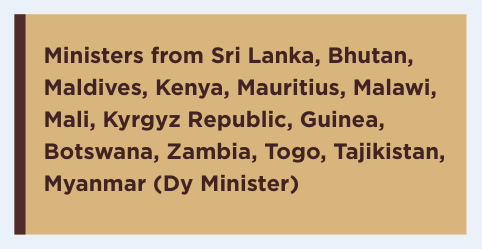
At the same time, countries are navigating these transitions un‑ der very different starting points ‑ legacy grids, policy frameworks, financing realities, and demand growth trajectories. This creates a valuable opportunity for shared learning: where global experiences offer tested solutions to emerging challenges, and where India’s own large‑scale implementation journey provides practical templates rele‑ vant to the world.


© Copyright , All rights reserved. Design by Andreal