







VOL. 18, ISSUE NO. 11 | February 2026

Spotlight





ECONOMIC SURVEY AND UNION BUDGET: A GIANT LEAP TOWARDS ‘VIKSIT BHARAT’
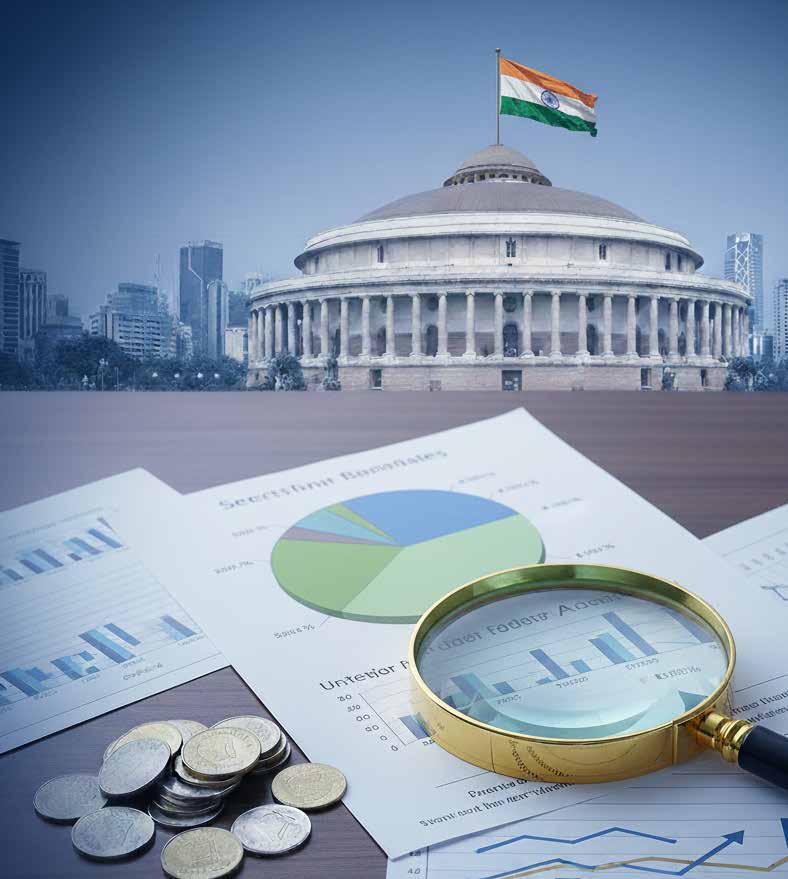

The Indian economy proved its resilience during the time of unprecedented adversity caused by COVID-19 led Pandemic as it was the quickest to recover from the medical crisis with a roadmap for sustained growth led by the exemplary “Atmanirbhar Bharat” farmed by our Hon’ble Prime Minister. Since then, India’s economic trajectory has been witnessing economic stability, fiscal discipline, sustained growth and manageable inflation. The First Advance Estimates (FAE) for Fiscal 2025-26 released by the Ministry of Statistics and Programme Implementation (MoSPI) projected the real GDP growth rate at 7.4% and the Gross value Added (GVA) growth rate at 7.3% surpassing earlier projections. Fiscal deficit has been decreasing and estimated to be at 4.4% in the ongoing fiscal. Headline inflation at 2.75% is also well tamed within the lower band of RBI’s targeted range of 2%- 6%. With an accelerated infrastructure development followed by robust manufacturing growth, record high foreign investments, and strong domestic demand, Indian economy has increasingly been gaining importance on the global stage with a promise to become a developed economy in future.
The global economyhowever has just been witnessing the reverse since the Pandemic. Slowdown in economic activities and even intermittent recession, intensifying geo-political conflicts, supply-chain disruption in trade due to sanctions and stringent protectionist measures especially by India’s major trade partners US and EU in the form of tariff and non-tariff barriers, and volatility in the financial markets including the currency market have been impacting the growth of emerging economies like India in an increasingly integrated world. Indian currency have depreciated against the US dollar to its lowest on record that crossed 90 market per US Dollar. The cause of concern for the domestic economy is more external than indegeneous.
At this juncture, the Economic Survey for fiscal 2025-26 and Union Budget for fiscal 2026-27 has been tabled in the Parliament. While the Survey analysed India’s economic performance in the current fiscal with a sectoral breakdown approach with recommendations for further improvement, the Union Budget has adopted measures to address the present concerns and to ensure a sustained as well as balanced growth combating the global adversities. Let’s now see what is contained for engineering sector in these two most important official documentsin line with our scope.
ECONOMIC SURVEY 2025-26
The Survey has pointed out that India is better off than its developed or emerging peers at the current situation due to its strong macroeconomic fundamentals. Although, risk of adversities can’t be ruled out, India can rely on its policies. India has several credits to its favour to achieve macro-economic stability in the last decade or so that includes strong focus on manufacturing, infrastructure, foreign trade and last but not the least, MSME sector. The Survey has outlined the performance of these strategically important sectors to show how they have helped India to achieve economic stability, and emphasized on in time and updated measures to maintain sustainability on economic performance.
INDUSTRY AND MANUFACTURING
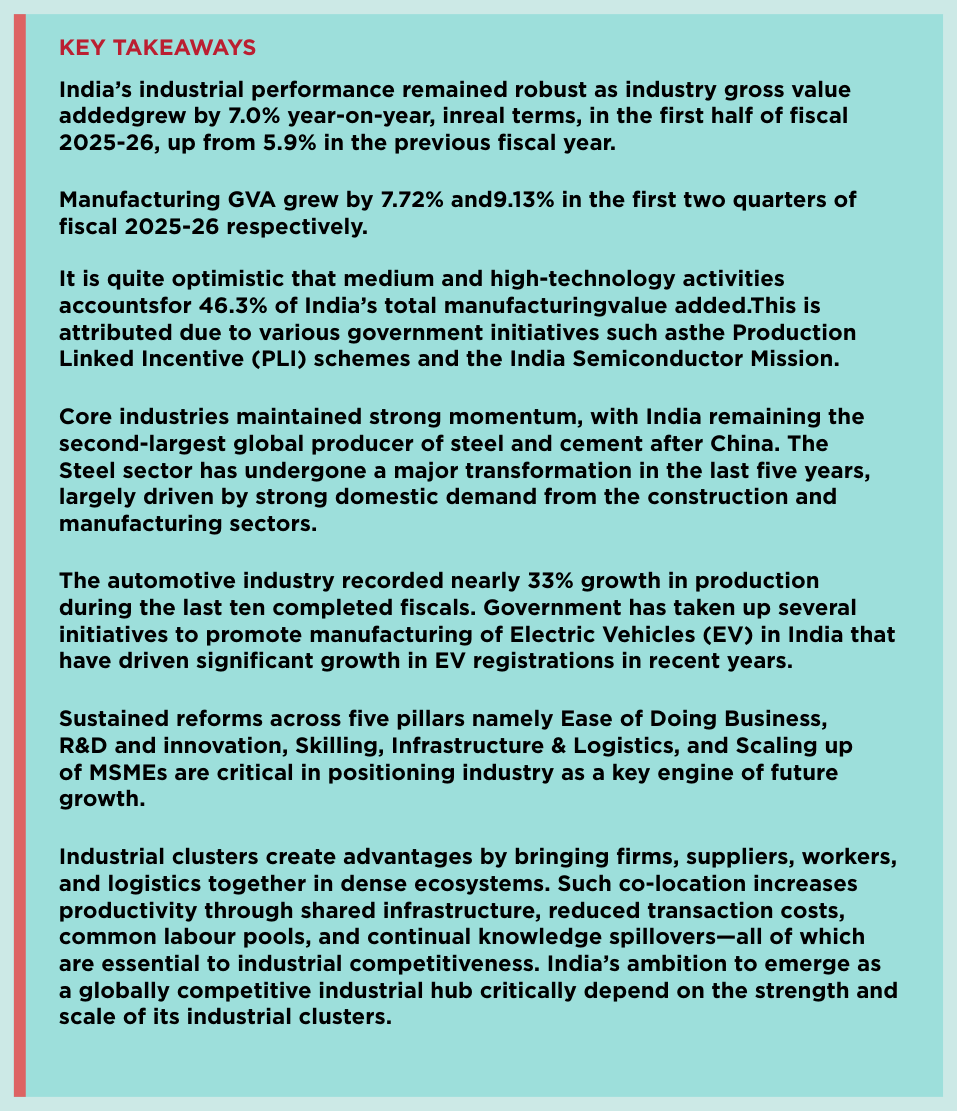
Industrial sector in fiscal 2025-26 continued to display resilience and further regained momentum despite persistent global headwinds. Manufacturing is recognisedas the most important component of industrial sector and the Survey argued that manufacturing competitiveness and exports are important for maintaining not only overall economic growth, but also for stability and strength of currency in the long-run.Importance of industrial cluster has also been recommended as a strategy to enhance global competitiveness.
The importance of higher Integration into the Global Value Chains (GVC) has been acknowledged in the Survey. India’s long-term success will depend on its ability to integrate intoGVCs as a high-tech, high-productivity manufacturing hub supported by stable and innovation-friendly policies. It hasalso been rightly recommended that the path to ‘Viksit Bharat @2047’ required strategic resilience and continuous ascent within the GVCs.
EXPORT SECTOR
The Survey pointed out that reconfiguration of global trade and investment flows has introduced both new constraints and opportunities for emerging economies. In this changing environment, India’s external performance confirmed its resilience to global shocks and spoke about the structural characteristics associated with a rapidly growing economy integrating more
deeply into global markets. India’s total exports reached USD 825.3 billion in FY25, driven by strong services and manufacturing export growth. Despite global trade tensions, India’s share in global merchandise exports rose to 1.8% by 2024, with strategies focusing on deep integration into GVCs, diversifying markets, and leveraging MSME participation.
A very impressive fact was mentioned that said expansion of higher-value manufacturing exports, especially in electronics, pharmaceuticals, and electrical machinery, along with diversification of export destinations and import sources, has strengthened resilience amid rising protectionism and tariff uncertainties.
MSMEs
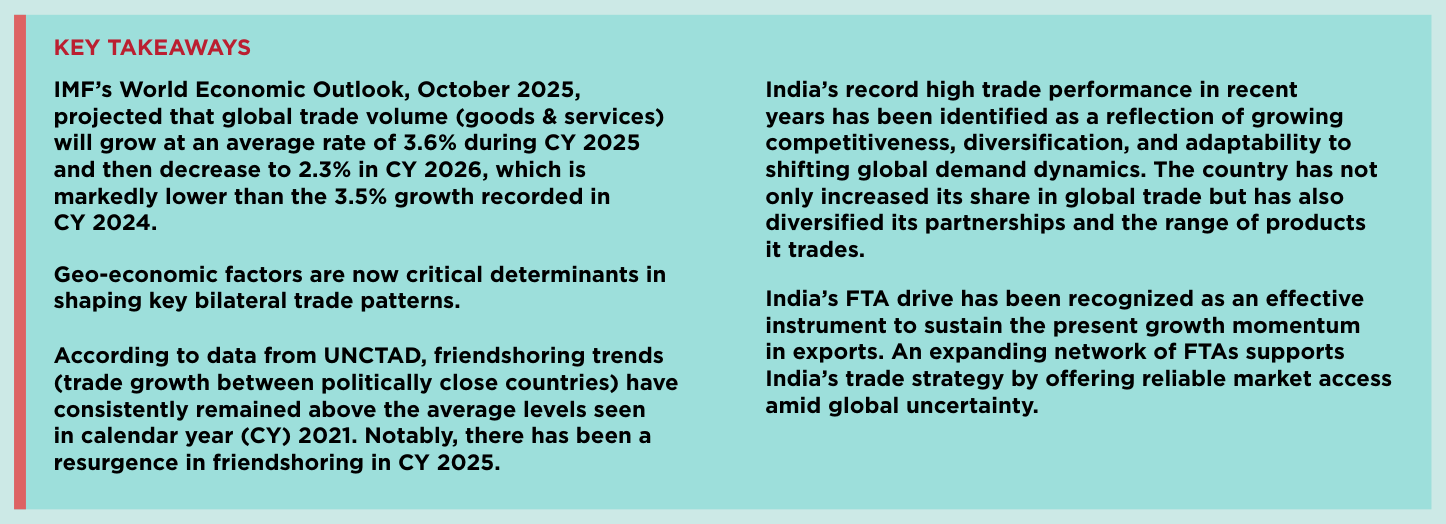
The Survey correctly linked manufacturing and exports with MSMEs and stated that overall advancement of MSMEs are inevitable for shaping up India as a global power in manufacturing. With India’s manufacturing sector positioned for greater global integration, MSME sector’s role is critical in enabling effective supply-chain participation, fostering local value addition, and supporting inclusive regional growth. Scaling up the MSMEs for global competitiveness should be an essential part of strategy for transition of India from a technology adopter to a global innovator. The survey in this connection described major initiatives of the government for promoting MSMEs and also addressed its major concern for enhancing global significance of Indian MSME sector.

INFRASTRUCTURE
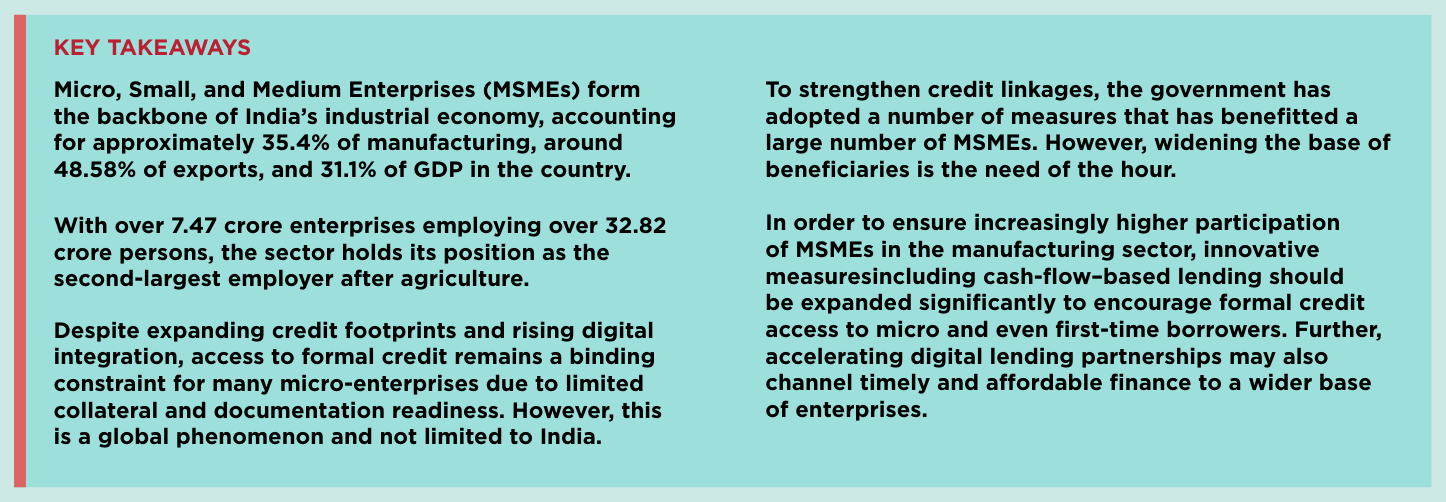
The Economic Survey 2025-26 highlighted a massive, sustained infrastructure push, with central capital expenditure surging 4.2 times from fiscal 2017-18 to a budgeted Rs. 11.21 lakh crore in fiscal 202526. Infrastructure in the Survey has been recognized as a key growth multiplier, with logistics costs dropping to 7.97% of GDP and significant expansions in railways, national highways and aviation.Several government initiatives have been taken up for developing different modes of infrastructure like Road transport, Railways Civil Aviation, Ports and Shipping, and Inland water transport that have improved Indian infrastructure to a significant extent in the post-COVID era and helped economy to grow by removing logistic constraints.
In fine, the survey efficiently found out India’s growth potential and revised growth figure accordingly. It correctly anticipated global headwinds and postulated the roadmap for medium to long term growth with proper policy implementation on Infrastructure, Manufacturing, Exports and MSMEs.
UNION BUDGET 2026-27
The Union Budget 2026-27, like the Economic Survey has estimated India’s underlying economic strength as the country has been achieving impressive growth with tamed inflation at the time of a dwindling global economy. Manufacturing sector has been identified as the key driver of India’s economic growth among industries and a key driver of next phase of growth. While global manufacturing output expanded modestly by 0.7% in the third quarter of calendar year 2025, India recorded manufacturing output growth of 1.3% during the same period. This performance reflects the strength of domestic fundamentals and sustained policy support for industrial expansion.Realising the importance of manufacturing, the Budget has reinforced support for manufacturing through targeted measures focusing on investment incentives, innovation, infrastructure development, and strengthening of overall industrial ecosystem.
The Budget, echoing the Economic Survey, has also emphasized on the development of MSME as the most vibrant component of manufacturing. As India’s manufacturing integrates further with global markets, MSMEs are to play a vital role in strengthening supply chains, promoting local value addition, and supporting inclusive regional development. The Budget accordingly unveiled a comprehensive set of measures for upgradation of Indian MSME sector at par with its global peers.
The Budget this time has been inspired on three Kartyavya and the first one is of relevance with engineering, to accelerate and sustain economic growth by enhancing productivity and competitiveness, and building resilience to volatile global dynamics.
Under the first Kartyavya, The Budget 2026-27 lists six step process to keep India ahead and proposed interventions in the following six areas:
1. Scaling up manufacturing in several strategic and frontier sectors.
2. Rejuvenating legacy industrial sectors.
3. Creating champion MSMEs.
4. Delivering a powerful push for infrastructure.
5. Ensuring long-term security and stability.
6. Developing city economic regions.

FOCUS ON MANUFACTURING
With a view to strengthen manufacturing and ensure more participation of the sector in building Indian economy towards a sustained path of economic development, the budget proposed -
Scaling up manufacturing in several strategic and frontier sectors
- Biopharma SHAKTI with an outlay of ₹10,000 crores over the next 5 years. This will build the ecosystem for domestic production of biologics and biosimilars.
- India Semiconductor Mission(ISM) 2.0: The ISM 1.0 expanded India’s semiconductor sector capabilities. Building on this, ISM 2.0 will be launched to produce equipment and materials, design full stack Indian IP, and fortify supply chains. The focus will also be on industry led research and training centres to develop technology and skilled workforce.
- The Electronics Components Manufacturing Scheme, launched in April 2025 with an outlay of ₹22,919 crore, already has investment commitments at double the target. It is propose to increase the outlay to ₹40,000 crore to capitalise on the momentum.
- Dedicated rare earth corridor:A Scheme for Rare Earth Permanent Magnets was launched in November 2025. It is now proposed to support the mineral-rich States of Odisha, Kerala, Andhra Pradesh and Tamil Nadu to establish dedicated Rare Earth Corridors to promote mining, processing, research and manufacturing.
- Three dedicated Chemical Parks:To enhance domestic chemical production and reduce import dependency, we will launch a Scheme to support States in establishing 3 dedicated Chemical Parks, through challenge route, on a cluster-based plug-and-play model.
- Strengthening capital goods capability: It is a determinant of productivity and quality across different sectors. Towards building this capacity, the following have been proposed:
» Hi-Tech Tool Rooms established by CPSEs at 2 locations as digitally enabled automated service bureaus that locally design, test, and manufacture high-precision components at scale and at lower cost.
» A Scheme for Enhancement of Construction and Infrastructure Equipment (CIE) will be introduced to strengthen domestic manufacturing of high-value and technologically-advanced CIE. This can range from lifts in a multi-story apartment, fire-fighting equipment, large and small, to tunnel-boring equipment for building metros and high-altitude roads.
» A Scheme for Container Manufacturing is proposed to create a globally competitive container manufacturing ecosystem, with a budgetary allocation of ₹10,000 crore over a 5 year period.
- For the labour-intensive Textile Sector, an Integrated Programme with 5 sub-parts is proposed.
Benefits for the engineering sector
- Among this measures, establishment of dedicated rare earth corridor is an important steps as export control by China as the largest supplier of rare earth elements has created uncertainty on the availability of the same, especially for engineering exporters and this measure is expected to resolve the issue.
- Capital goods is also of significant strategic importance as this sector is a critical driver ofinfrastructure expansion, industrial capacity creation, and technological advancement across the economy. The Union Budget 2026-27 further reinforces this direction, emphasising the need to support a rapidly expanding economy characterised by rising trade volumes and increasing capital requirements. Capital goods covers a sizeable part of engineering and measures to strengthen capability of this segment will be a big cheer for manufacturers and exporters from engineering sectors.
Building Champion MSMEs as a Centre of Growth
Under the first Kartyavya, MSME has also been mentioned along with manufacturing and capital goods and adequate stress has been given to promote the Indian MSMEs to make them able to compete at the global level. A three-pronged approach has been proposed to help Indian MSMEs grow as Champions by providing equity, liquidity and professional support.
Equity support
- Introduction of a dedicated ₹10,000 crore SME Growth Fund, to create future Champions, incentivizing enterprises based on select criteria.
- Proposal to top up the Self-Reliant India Fund set up in 2021, with ₹2,000 crore to continue support to micro enterprises and maintain their access to risk capital.
Liquidity Support through TReDS
With TReDS, more than ₹7 lakh crore has been made available to MSMEs. To leverage its full potential, four measures were proposed:
- Mandate TReDS as the transaction settlement platform for all purchases from MSMEs by CPSEs, serving as a benchmark for other corporates.
- Introduce a credit guarantee support mechanism through CGTMSE for invoice discounting on the TReDS platform.
- Linking GeM with TReDS to encourage cheaper and quicker financing.
- TReDS receivables as asset backed securities, to develop a secondary market and enhance liquidity and settlement of transactions.
Professional support
- Government to facilitate Professional Institutions to develop ‘Corporate Mitras’ especially in Tier-II and Tier III towns, to help MSMEs meet compliance requirements at affordable costs.
Tax Support
Complete removal of the current value cap of ₹10 lakh per consignment on courier exports to support aspirations of India’s small businesses, artisans and startups.
Benefit for engineering
MSME comprises a considerable part of engineering and hence, measures adopted for facilitating MSME sector will be beneficial for engineering sector. Even the large engineering firms will also be benefitted as MSME acts as a linkage for them. The removal of current value cap is likely to boost cross-border e-commerce, streamline logistics, and support rapid expansion for small-scale exporters.
Other measures related to engineering sector
Rejuvenation of Legacy Industrial Clusters
In line with the recommendation of the Economic Survey 2025-26, it is proposed to introduce a Scheme to revive 200 legacy industrial clusters to improve their cost competitiveness and efficiency through infrastructure and technology upgradation.
Urbanisation: City Economic Regions
- Amplifying the potential of cities to deliver the economic power of agglomerations.
- Focus on Tier II, Tier III cities, and temple-towns.
- ‘Growth Connectors’ - 7 HighSpeed Rail corridors between cities Mumbai-Pune, Pune-Hyderabad, Hyderabad-Bengaluru, Hyderabad-Chennai, Chennai-Bengaluru, Delhi-Varanasi, VaranasiSiliguri - Environmentally sustainable passenger systems.
Carbon Capture Utilization and Storage (CCUS)
- Aligning with the roadmap launched in December 2025, CCUS technologies at scale will achieve higher readiness levels in end-use applications across five industrial sectors, including, power, steel, cement, refineries and chemicals. An outlay of ₹20,000 crore is proposed over the next 5 years.
Ease of doing business
- A single and digitally connected window for seamless processing of approvals required from various government agencies for cargo clearance will be launched by the end of the financial year
- For goods not requiring any compliance, immediate clearance will be done by the Customs after online registration is completed by the importer, subject to payment of duty
- Customs integrated system will be rolled out in 2 years as a single, integrated and scalable platform for all customs processes
Impact on engineering
Development of industry and infrastructure will not be completed without engineering as the most crucial integral component. Construction sector contains steels and machineries as important constituents. As the largest foreign exchange earner for India, engineering contributes to around onefourth of exports and hence, it has vast presence across different well defined sectors.
Measures to promote export competitiveness and import substitution
Customs related measures
- Enhance duty deferral period for tier 2 and 3 AEOs (Authorised Economic Operators) from 15 to 30 days. Eligible manufacturerimporters will get the same facility
- Extension of validity period for advanced ruling binding on customs from 3 years to 5 years
- Recognition of regular importers in the risk systems so that the verification requirement of their cargo every time can be minimized
- Export cargo through electronic sealing to be provided through clearance from factory to ship
- For import of goods which do not need any compliance, filling of the bill of entry by a trusted importer and arrival of goods will be automatically notified to the customs for completing clearance approvals
- C u s t o m s - w a r e h o u s i n g framework will be transformed into a warehouse operationcentric system will selfdeclarations, electronic tracking and risk-based audits
Sector-wise customs duty exemptions
1. Renewable energy sector:
- Extension of BCD exemption on Capital goods imported for manufacturing of lithium-ion cells for batteries, and battery energy storage systems
- BCD exemption on Sodium Antimonate, a critical raw material for the processing of solar glass
- Critical minerals
- BCD exemption for capital goods imported for processing of critical minerals in India
- Nuclear power:
- Extension of BCD exemption on goods imported for nuclear power projects till 2035 and expand it for all nuclear plants irrespective of their capacity
4. Aircrafts, spacecrafts and parts:
- BCD exemption on components and parts used in manufacturing of civilian, training and other aircrafts
- BCD exemption on raw materials imported for manufacturing parts of aircrafts used in MRO activity by units in defence sector
5. Consumer appliances:
- BCD exemption on specific components and parts used in manufacturing of microwave ovens
In the Union Budget 2026-27, the Government has undertaken comprehensive economic reforms towards creating employment, boosting productivity and accelerating growth. The budget has rightly recognized the key sectors that will be leading India to shape up as a developed economy in line with ‘Viksit Bharat’ by 2047, identified the strengths and weaknesses of each of the growth engines of India and adequately addressed the constraints with a series of innovative and timely measures to ensure balanced growth and development both for the people and the economy as a whole. Engineering sector is a certain beneficiary as infrastructure, manufacturing, capital goods and MSMEs are the major focus of the budget that have received much needed support from the budget. Customs related measures are likely to support domestic manufacturers and enhance exports of engineering products at the same time.


© Copyright , All rights reserved. Design by Andreal