







VOL. 18, ISSUE NO. 5 | August 2025

Tech Story





ABSTRACT
As industries worldwide committed to reduce their carbon footprint, the foundry sector stands out as a key area where sustainability can make a significant impact on the environment. Integrating Artificial Intelligence (AI) into foundry operations offers advanced solutions to increase efficiency, increase profitability, reduce waste, and promote eco-friendly practices. This article explores deeply into why AI is becoming essential for sustainable foundry operations and how it can transform the foundry industry for the better greener and eco-friendly organisation.
With modernisation and automation in the foundry processes, slowly foundry manpower requirements are turning from unskilled many to skilled few. Foundry Industry has witnessed exponential growth both in terms of volumes and technology. With the advent of new technologies, foundry operations are becoming more reliable and sustainable. Sustainability and reducing carbon footprints using Artificial intelligence, a new technology that is gaining more and more importance, support mistake proofing, cost reduction, MIS preparation, global sustainability compliances and plugging manual errors in all areas. Visual AI in Melting Operations control, Weighbridge automation, Moulding and Post-production areas are a few examples discussed in this article that help in realising all the above-mentioned benefits.
INTRODUCTION
The Climate change refers to significant and lasting shifts in global or regional climate patterns, primarily marked by a rise in average global temperatures. This phenomenon poses serious environmental challenges and necessitates urgent action to mitigate its impacts on ecosystems and human societies.
With the introduction of the transition phase of the CBAM (Cross Boader Adjustment Mechanism) tax from October 2023, it has become mandatory for all the exporters to the European Union to start measuring embedded carbon emissions for both installations and CBAM products. The Carbon Border Adjustment Mechanism (CBAM) is a carbon pricing system implemented by the European Union (EU) to combat carbon leakage and promote global climate action. It aims to put a fair price on the carbon emissions embedded in certain goods imported into the EU, ensuring a level-playing field for EU producers who operate under the EU’s Emissions Trading System (ETS). Artificial intelligence (AI) is transforming manufacturing into a sustainable cost-effective unit by assisting the process in many areas:
- Predictive maintenance: AI systems will analyse data from all the equipments in furnaces, moulding machines, sand plant to predict when a part might fail or require maintenance. AI systems are integrated with the equipment PLC systems or data logger to collect the data and predict the results. This helps in reducing downtime and extending the lifespan of equipment.
- Quality control: AI-powered vision systems can inspect products for defects with high precision. If the human quality checks are missed, this can also be tracked with AI.
- Supply chain optimisation: AI systems will be interfaced with the plant ERP system, which helps in the continuous monitoring of demand, inventory levels, and also material inward/outward through our weighbridge automation on real-time basis.
- Process automation: AI enables automation of complex manufacturing processes. Robots and automated systems, guided by AI, can perform tasks like the complete, melting process - starting from charging of scrap to tapping of metal and pouring, assembly of cores, movement of cores, counting of castings from shakeout/shot blasting/fettling and despatch with high accuracy and speed.
- Energy management: Visual AI with PLC interface can optimise energy consumption by analysing patterns and suggests adjustments to reduce power. This lowers costs and supports in reducing process carbon footprint associated with the process and ensures sustainability efforts.
Overall, AI in manufacturing leads to reduced carbon footprint, increased efficiency, reduced costs, improved quality and greater flexibility. It’s a key driver in the Melting, Sand Plant and Coreshop are sections where metal is melted, sand is prepared and cores are produced respectively for the moulding line. Sand is used for preparing the mould, cores are placed in the mould and metal is poured. Process parameters and emissions at each stage of production is calculated and recorded. AI utilises data from visual cameras, PLC systems of equipments and data loggers. All these calculations are based on GHG protocol and EPA protocols which complies with the emission standards.
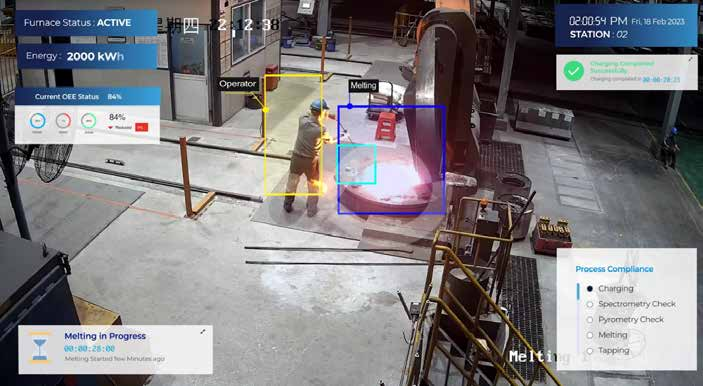
Implementation of AI system in melting operation is shown in Fig.2. All the operations of melting are tracked starting from charging scrap into furnace, temperature measurement, spectrometer sample checking and pouring along with real times associated with operations.
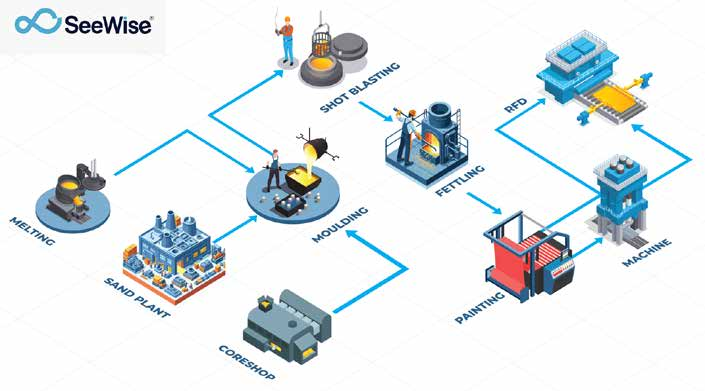
Fig 3: How each stage of melting process is captured using the most advanced AI solutions
APPLICATION IN THE FOUNDRY PROCESS
In order to achieve reduction in carbon footprint in foundry operations, one can utilise AI to derive at customer-specific solutions based on the foundry requirements.
Simple foundry operations process flow architecture is shown in Fig 1.
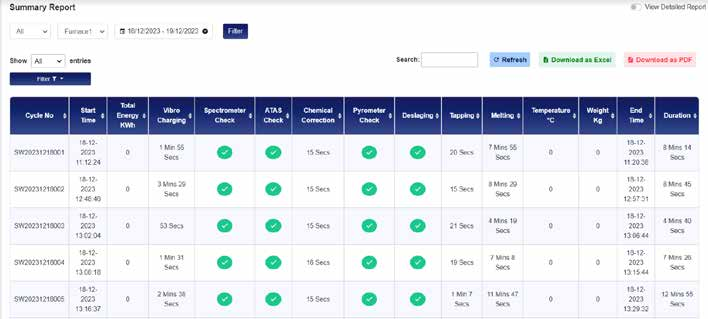
Summary report of each hour / shift / day / month can be easily retrieved and reports can be printed without relying on traditional log sheets. These outputs can also be integrated with your ERP system for production and delays entry.
Complete AI architecture ensures data security with 3-layer data protection system. Figure 3 shows how each stage of melting process is captured using the most advanced AI solutions extended towards sustainability compliances with emissions measurement.
CONCLUSION
With the complexity of foundry operations, measuring, monitoring and complying with each operation procedures is diverse in nature and effort has been put to completely do the automation using AI, which generates the production reports and sustainability compliance reports in one go. Becoming sustainability compliant is not an one-day affair, it is a long journey and let us start this long journey today to own responsibility towards the next generations and planet earth. Sustainability is not only a concern of protecting the green, but also protecting our Business from International norms and Government compliances. Let’s work together to make our foundry industry to become Artificial Intelligence enabled Sustainability Compliant.


© Copyright , All rights reserved. Design by Andreal