







VOL. 19, ISSUE NO. 7 | October 2026

Focus





INDIA MAJOR CENTRAL STAKEHOLDER AT BRICS SUMMIT
BRICS: An Emerging Economic Force
Evolved from a Wall Street investment concept decades ago, BRICS has with time been shaped up as an economic bloc of major emerging economies and turned into a significant geopolitical and economic platform challenging Western-dominated global institutions.Originally comprising Brazil, Russia, India, China, and South Africa, the grouping has expanded its membership in recent years, reflecting the growing influence of emerging economies in global affairs. Today, the bloc comprises 11 full members namely Brazil, Russia, India, China, South Africa, Egypt, Ethiopia, Iran, the United Arab Emirates, Saudi Arabia and Indonesia, representing around 50% of the global population, 40% of global GDP by purchasing power parity, and 20% of global trade.
The significance of BRICS lies in both its economic weight and its political diversity. Its members represent different regions, political systems, development models and foreign-policy priorities. This diversity can make consensus difficult, but it also gives the grouping a wide geographical reach across Asia, Africa, the Middle East and Latin America.
Objective of BRICS
Cooperation in BRICS is conducted through consultation, consensus and practical coordination. The framework operates across three broad pillars namely Political and security cooperation, Economic and financial cooperation, and finally, Cultural and people-to-people exchanges.
Objectives of Forming BRICS
- Global Governance Reform: Advocate for fairer representation of developing nations in major international institutions like the UN, IMF, and World Bank.
- Economic Cooperation: Boost trade, investment, and technological collaboration among member states.
- Financial Autonomy: Reduce reliance on Western-dominated financial systems by establishing alternatives like the New Development Bank (NDB) and the Contingent Reserve Arrangement.
- Promoting Multipolarity: Balance traditional Western-centric global power structures with a cooperative framework rooted in international law and sovereign equality.
Objectives of Expanding BRICS
- Enhancing Global South Influence: Incorporating new members and partner countries increases the bloc’s demographic and economic weight, making its advocacy for institutional reform harder to ignore.
- Geographical and Economic Diversity: Welcoming resource-rich nations (such as major energy producers in the Middle East) secures critical supply chains and energy security.
- Alternative Financial Settlement: Broaden local currency trading networks and reduce vulnerability to unilateral economic sanctions or U.S. dollar dominance.
Flagship Achievement of BRICS: New Development Bank
The bloc’s most tangible institutional achievement is the New Development Bank (NDB) that was established at the 2014 Fortaleza Summit and became operational from 2015. Headquartered in Shanghai, the NDB was created to finance infrastructure and sustainable development projects in emerging markets, offering an alternative to the World Bank and IMF.
Current Status of NDB
According to the bank’s 2025 Annual Report, it approved 19 projects worth USD 3.171 billion during 2025. Its portfolio at the end of that year consisted of 115 projects, with total approved financing of USD 35.593 billion.
The bank’s approved projects cover areas such as clean energy, water and sanitation, transport infrastructure, digital infrastructure, environmental protection and social infrastructure. This provides BRICS a practically developmentfinance mechanism alongside its political consultations.

Contingent Reserve Arrangement
Alongside the NDB, BRICS established the Contingent Reserve Arrangement (CRA) in 2014 as a $100 billion currency swap facility to provide liquidity support during balance-of-payments crises. The CRA serves as a financial safety net, reducing members’ dependence on IMF
BRICS and the Changing World Order
As the member countries of BRICS collectively represent a substantial share of the world’s population and economic activity, it reflects the broader shift in global economic and political power toward emerging economies. As its member increases, participation and hence, importance of BRICS in global economic stage has been increasing steadily. With time, the group has become an important platform for discussions about reforming global institutions and creating a more multipolar international system.
INDIA at BRICS

Being the fastest growing and one of the largest economy with a strong resilience to wither external shocks as seen during the Pandemic, India's significance on the international platform has been rapidly increasing and its attraction as a trade and investment destination has been skyrocketed of late. Run by a strong reformist government for more than an era, India has achieved substantial improvement in its technological upgradation and hence uplifted its negotiation skill with the developed world. India is now a key anchor for strategic autonomy, a voice for the Global South, and a pragmatic balancer against dominance by any single power.India's role in BRICS has therefore been amplified with time that placed him in the position of a strategy-maker within BRICS.India ensures BRICS does not morph into a rigid, anti-Western bloc, maintaining constructive ties with Western partners while engaging the coalition.
India champions the developmental priorities, digital public infrastructure, and increasing and its attraction as a trade and investment destination has been skyrocketed of late. Run by a strong reformist security concerns of emerging and developing nations, while at the same time, India uses the forum to push for long-overdue reforms in global governance bodies like the United Nations, WTO and financial institutions. For India, BRICS provides an opportunity to strengthen relationships with other major emerging economies while advocating for greater representation of developing countries in global institutions.
India steers the bloc toward practical, results-oriented cooperation in agriculture, health, energy, and supplychain resilience highlighted during its recent chairship of the 18thBRICS Summit in New Delhi during September 2026.
India’s Merchandise Trade with BRICS
BRICS is a very prominent and strategically important trade government for more than partner of India with China being the largest trade partner. India’s exports to other tenBRICS an era, India has achieved substantial improvement in its technological upgradation and hence uplifted its negotiation skill with the developed world. India is now a key anchor for strategic autonomy, a voice for the Global South, and a pragmatic balancer against countries taken together accounts for over one-fifth of India’s global merchandise exports while India’s combined import from other BRICS nations is more than two-fifth of India’s global merchandise imports. India is at present having a trade deficit with BRICS due to substantially high import from China.
The following tables show India’s merchandise trade with other BRICS nations:
India’s Merchandise Exports to BRICS (Values in USD Million)
| Country | 2024-2025 | 2025-2026 | Growth (%) | Share in BRICS (%) |
|---|---|---|---|---|
| BRAZIL | 6,771.01 | 7,022.10 | 3.71 | 7.34 |
| CHINA | 14,252.21 | 19,471.08 | 36.62 | 20.35 |
| EGYPT | 3,411.36 | 3,874.81 | 13.59 | 4.05 |
| ETHIOPIA | 476.81 | 438.15 | -8.11 | 0.46 |
| INDONESIA | 5,380.18 | 4,491.36 | -16.52 | 4.69 |
| IRAN | 1,241.15 | 1,258.69 | 1.41 | 1.32 |
| RUSSIA | 4,881.30 | 4,493.51 | -7.94 | 4.70 |
| SAUDI ARABIA | 11,756.65 | 10,281.13 | -12.55 | 10.74 |
| SOUTH AFRICA | 7,462.28 | 7,008.41 | -6.08 | 7.32 |
| UAE | 36,638.02 | 37,359.11 | 1.97 | 39.04 |
| Total to BRICS | 92,270.99 | 95,698.34 | 3.71 | --- |
| Share of BRICS (%) | 21.08 | 21.68 | --- | --- |
UAE is the largest export destination for India with BRICS sharing 39% of India’s total exports to BRICS while China shares 20% being the second largest export destination. Saudi Arabia is another country with share in double-digit.
India’s Merchandise Import from BRICS (Values in USD Million)
| Country | 2024-2025 | 2025-2026 | Growth (%) | Share in BRICS (%) |
|---|---|---|---|---|
| BRAZIL | 5,435.01 | 8,050.43 | 48.12 | 2.50 |
| CHINA | 113,447.34 | 131,620.29 | 16.02 | 40.90 |
| EGYPT | 1,328.53 | 2,603.24 | 95.95 | 0.81 |
| ETHIOPIA | 73.38 | 248.51 | 238.66 | 0.08 |
| INDONESIA | 22,778.03 | 20,291.68 | -10.92 | 6.31 |
| Country | 2024-2025 | 2025-2026 | Growth (%) | Share in BRICS (%) |
|---|---|---|---|---|
| IRAN | 441.83 | 375.46 | -15.02 | 0.12 |
| RUSSIA | 63,811.44 | 55,363.11 | -13.24 | 17.20 |
| SAUDI ARABIA | 30,121.12 | 30,790.22 | 2.22 | 9.57 |
| SOUTH AFRICA | 10,547.45 | 8,560.18 | -18.84 | 2.66 |
| UAE | 63,403.01 | 63,888.81 | 0.77 | 19.85 |
| Total to BRICS | 311,387.14 | 321,791.91 | 3.34 | --- |
| Share of BRICS (%) | 43.18 | 41.48 | --- | --- |
Among the BRICS member states, China is the largest supplier to India with around 40% of India’s total import from BRICS. UAE and Russia supplies 20% and 17% of total import from BRICS by India.
India’s Balance of Trade with BRICS (Values in USD Million)
| Country | 2024-2025 | 2025-2026 |
|---|---|---|
| BRAZIL | 1,336.00 | -1,028.33 |
| CHINA | -99,195.13 | -112,149.21 |
| EGYPT | 2,082.83 | 1,271.57 |
| ETHIOPIA | 403.43 | 189.64 |
| INDONESIA | -17,397.85 | -15,800.32 |
| IRAN | 799.32 | 883.23 |
| RUSSIA | -58,930.14 | -50,869.60 |
| SAUDI ARABIA | -18,364.47 | -20,509.09 |
| SOUTH AFRICA | -3,085.17 | -1,551.77 |
| UAE | -26,764.99 | -26,529.70 |
| BRICS Total | -219,116.15 | -226,093.57 |
India concedes trade deficit with seven out of 10 member nations of BRICS except Ethiopia and Iran with. China is the country India suffers highest trade deficit with followed by Russia and the UAE.
Major traded commodities: India’s major traded commodities with BRICS nations include products from commodity groups namely Minerals fuels, Gems and Jewellery, Electric machinery and equipment, Nuclear reactors and boilers, Motor vehicles and organic chemicals among others. Both India’s export and imports baskets are dominated by these commodity groups but products of exports and imports are different.
India’s prominence in BRICS trade has been reflected by the figures as India’s share in BRICS trade is increasing with time. Moreover, India is also moving up in the global list of countries based on size of the GDP where it is the second largest in BRICS only after China. At this juncture, the significance of India holding its fourth Chairship in BRICs summit is immense.
BRICS Summit 2026 in New Delhi
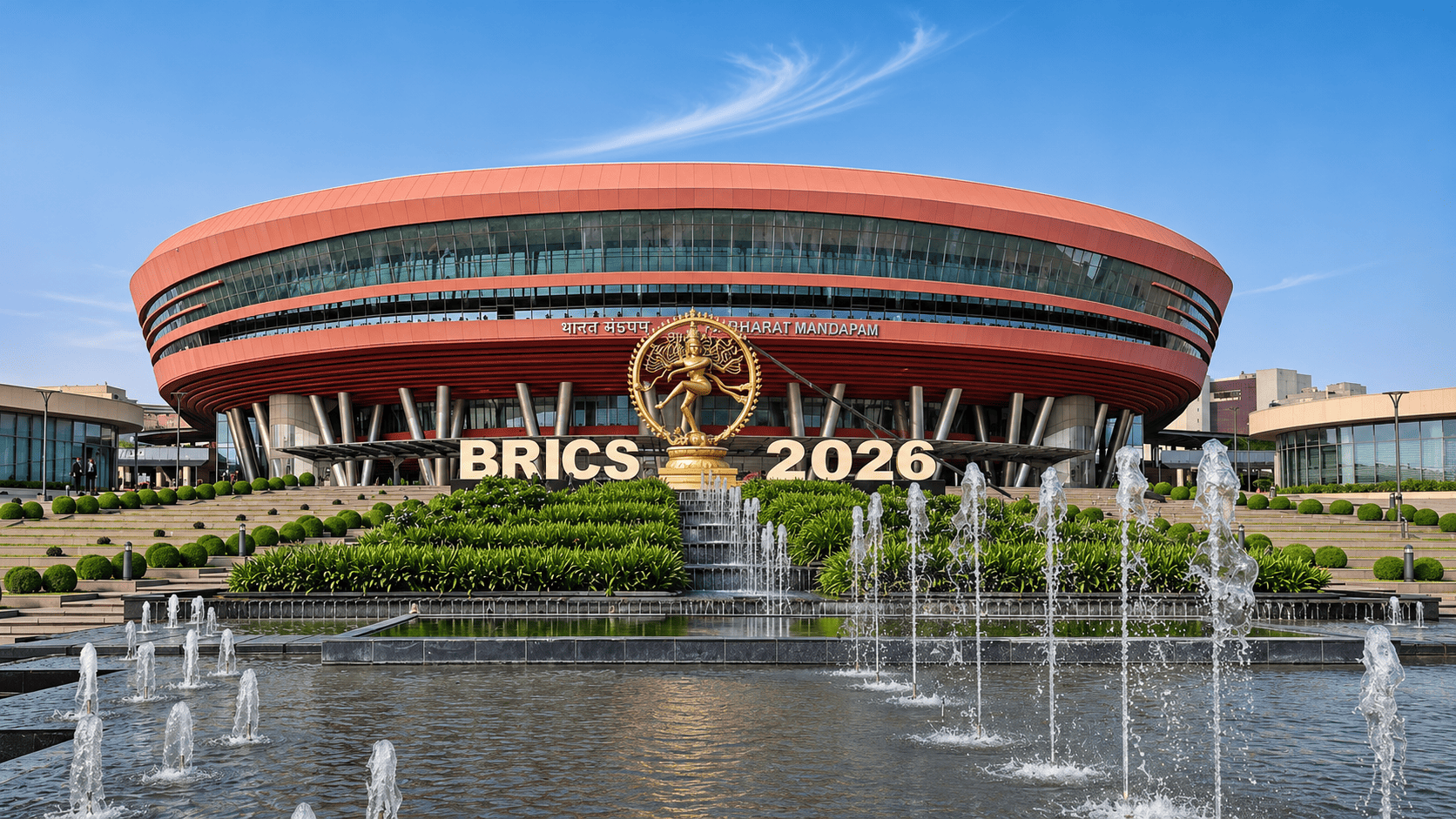
India hosted the 18th BRICS Summit at Bharat Mandapam in New Delhi on 12–13 September 2026. The meeting brought together leaders of eleven BRICS member countries, partner countries and outreach invitees.
India’s Role: India assumed the BRICS chairship on 1 January 2026, its fourth chairship after 2012, 2016 and 2021. The year also marked two decades since the establishment of BRICS. India chose the theme “Building for Resilience, Innovation, Cooperation and Sustainability”, reflecting a people-centred approach rooted in the principle of “Humanity First”.
Global scenario: The summit took place against a backdrop of geopolitical crisis especially among major trade routes, economic uncertainty, trade restrictions and debates over the future of multilateral institutions. Indian government identified the strengthening of intra-BRICS cooperation and discussion of global and regional issues as central objectives of the meeting.
Declaration: The summit produced the BRICS New Delhi Declaration, which was adopted by consensus. The declaration reaffirmed the principles of sovereign equality, mutual respect, solidarity, openness, inclusiveness, collaboration and consensus. It also welcomed the contribution of partner countries and supported greater engagement with emerging markets and developing countries.
Major issues emphasized
- A joint New Delhi Declaration: The 11-member BRICS agreed on a broad 140-point declaration covering global governance, security, trade, development, technology and sustainability.
- West Asia diplomacy: Leaders called for maximum restraint, dialogue and diplomacy amid the escalating conflict in the Middle East. Reaching consensus was particularly significant because BRICS includes both Iran and the UAE.
- Stronger economic cooperation, but no BRICS currency: Rather than creating a common currency, members emphasized settling more trade and investment in local currencies, improving interoperability of payment systems, and expanding local-currency financing through the New Development Bank.
- New financial mechanisms: India’s proposal for a BRICS Risk Lab at GIFT City received support, while members backed phased development of a new investment platform.
- Technology and AI: BRICS backed greater cooperation on artificial intelligence, particularly safe, inclusive and equitable access for the Global South. A digital publicinfrastructure repository and other technology initiatives were also supported.
- Development and industrial cooperation: Initiatives included a BRICS Training Hub Network, mental-wellness centres, a Centre for BRICS Industrial Competencies, and a BRICS-NDB Knowledge Portal, alongside cooperation on health, agriculture, energy and Industry 4.0.
- Terrorism: India secured particularly strong language condemning terrorism, including reference to the Pahalgam attack, while the declaration called for action against terrorism financing and safe havens.
- Global-governance reform: BRICS reiterated its push for greater representation of developing countries in institutions such as the UN Security Council, IMF and World Bank, reinforcing its broader Global South agenda.
The summit’s main significance was pragmatic rather than revolutionary. BRICS did not launch the much-discussed common currency; instead, it concentrated on local-currency payments, financial resilience, AI, development finance and Global South representation, while trying to maintain diplomatic unity despite serious disagreements among members.
India also emerged with a stronger diplomatic profile, particularly because it helped broker consensus on the sensitive West Asia language and pushed anti-terrorism and development priorities into the final declaration.
Indian Engineering and BRICS
The BRICS grouping has emerged as an important platform for economic cooperation among major emerging economies.For India, its relationship with BRICS countries has significant implications for manufacturing, infrastructure, technology, investment and engineering exports. The expansion of BRICS has further increased the potential market available to Indian engineering companies.
The performance of Indian engineering exports has been remarkable in last few years, especially during the post-COVID era. In the last five years after the Pandemic, engineering exports recorded a sharp increase from USD 76.7 billion in 2020-21 to USD 122.4 billion in fiscal 2025-26 securing a CAGR of nearly 10%. During these time period, engineering exports from India achieved its record high for three times in five years. The strong growth of India’s engineering exports demonstrates that Indian manufacturers already possess substantial international competitiveness.
Engineering Trade between India and BRICS
The BRICS bloc, is the largest economic region for India as destination for its engineering exports. In line with merchandise exports, engineering exports to BRICS also share around 20% of India’s global engineering exports. North America and EU are the two other regions sharing around one-fifth of India’s global engineering exports. The following tables show the picture.
India’s Engineering Exports to BRICS Countries (Values in USD Million)
| COUNTRIES | 2024-25 | 2025-26 | Growth (%) | Share in BRICS (%) |
|---|---|---|---|---|
| BRAZIL | 2238.00 | 2497.74 | 11.61 | 9.92 |
| CHINA | 2667.47 | 3531.09 | 32.38 | 14.02 |
| EGYPT | 917.56 | 994.81 | 8.42 | 3.95 |
| ETHIOPIA | 122.91 | 123.84 | 0.76 | 0.49 |
| INDONESIA | 1938.54 | 1608.84 | -17.01 | 6.39 |
| IRAN | 43.27 | 43.31 | 0.09 | 0.17 |
| RUSSIA | 1228.08 | 1137.21 | -7.40 | 4.52 |
| SAUDI ARABIA | 5635.38 | 4892.99 | -13.17 | 19.43 |
| SOUTH AFRICA | 2517.98 | 2895.27 | 14.98 | 11.50 |
| UAE | 8277.50 | 7457.78 | -9.90 | 29.61 |
| TOTAL BRICS | 25586.69 | 25182.90 | -1.58 | --- |
| Share of BRICS in India’s global engineering exports in FY26: 20.57% |
India’s engineering exports to BRICS was recorded at USD 25.2 billion in 2025-26, which is 20% of India’s global engineering exports. UAE is the largest export destination within BRICS with 29.6% share in total exports to BRICS followed by Saudi Arabia, China, South Africa and Brazil.
India’s Engineering Exports to BRICS Countries (Values in USD Million)
| COUNTRIES | 2024-25 | 2025-26 | Growth (%) | Share in BRICS (%) |
|---|---|---|---|---|
| BRAZIL | 616.53 | 648.51 | 5.19 | 1.12 |
| CHINA | 37194.36 | 43331.55 | 16.50 | 74.84 |
| EGYPT | 55.36 | 54.77 | -1.06 | 0.09 |
| ETHIOPIA | 5.44 | 3.37 | -38.04 | 0.01 |
| INDONESIA | 3362.09 | 2891.11 | -14.01 | 4.99 |
| IRAN | 1.44 | 1.39 | -3.72 | 0.00 |
| RUSSIA | 1224.35 | 1556.72 | 27.15 | 2.69 |
| SAUDI ARABIA | 1921.85 | 2157.42 | 12.26 | 3.73 |
| SOUTH AFRICA | 469.29 | 446.61 | -4.83 | 0.77 |
| UAE | 6190.10 | 6805.82 | 9.95 | 11.75 |
| TOTAL BRICS | 51040.82 | 57897.26 | 13.43 | --- |
| Share of BRICS in India’s global engineering imports in FY26: 35.51% |
BRICS control the Indian engineering market as a bloc more than India controls the engineering market of BRICS as a whole. BRICS countries together supplies over 35% of India’s engineering demand from overseas. China alone supplies three-fourth of India’s total engineering imports from BRICS while UAE supplies 12% of the same.
India’s Engineering Balance of Trade with BRICS Countries (Values in USD Million)
| COUNTRIES | 2024-25 | 2025-26 |
|---|---|---|
| BRAZIL | 1621.47 | 1849.22 |
| CHINA | -34526.89 | -39800.46 |
| EGYPT | 862.20 | 940.04 |
| ETHIOPIA | 117.47 | 120.47 |
| INDONESIA | -1423.55 | -1282.27 |
| IRAN | 41.83 | 41.93 |
| RUSSIA | 3.73 | -419.51 |
| SAUDI ARABIA | 3713.53 | 2735.57 |
| SOUTH AFRICA | 2048.69 | 2448.67 |
| UAE | 2087.40 | 651.96 |
| TOTAL BRICS | -25454.13 | -32714.36 |
India concedes trade deficit in engineering goods with only three countries of BRICS but enjoys surplus with the rest seven. However, it is a deficit altogether with BRICS nations combined as deficit with china far exceeds the total surplus with other countries. India is in a better position in engineering trade in comparison to the broader merchandise where Indian faced deficit with seven BRICS member nations.
Major Engineering Product Groups Exported to BRICS (Values in USD Million)
| Engineering Panels Exported to BRICS | 2024-25 | 2025-26 | Growth (%) | Share in BRICS (%) |
|---|---|---|---|---|
| Motor vehicle/cars | 4002.37 | 4140.11 | 3.44 | 16.44 |
| Copper and products made of copper | 1087.73 | 1958.26 | 80.03 | 7.78 |
| Products of iron and steel | 1871.21 | 1753.14 | -6.31 | 6.96 |
| Ship, boat and floating structure | 1508.95 | 1743.26 | 15.53 | 6.92 |
| Electric machinery and equipment | 1607.92 | 1669.92 | 3.86 | 6.63 |
| Industrial Machinery for dairy, agricultural, food processing etc. | 1648.34 | 1640.89 | -0.45 | 6.52 |
| Auto components/parts | 1400.91 | 1617.30 | 15.45 | 6.42 |
| Iron and steel | 1608.93 | 1566.32 | -2.65 | 6.22 |
| IC engines and parts | 928.07 | 984.19 | 6.05 | 3.91 |
| Aluminium and products of aluminium | 755.63 | 971.31 | 28.54 | 3.86 |
| Other construction machinery | 842.81 | 910.77 | 8.06 | 3.62 |
| ATM, injection moulding machinery etc. | 713.78 | 820.49 | 14.95 | 3.26 |
| AC, refrigeration machinery etc. | 524.83 | 606.41 | 15.54 | 2.41 |
| Medical and scientific instrument | 540.12 | 590.27 | 9.29 | 2.34 |
| Auto tyres and tubes | 540.04 | 526.48 | -2.51 | 2.09 |
India is a major automobile supplier in Africa and some of the middle-east countries. Copper and products is the second largest exported product group to BRICS mainly due to substantial consumption by Saudi Arabia and China. Iron and steel and its products are exported to majority of the BRICS member nations by India.

Country-wise Major Engineering Product Groups Exported
Among the BRICS countries, engineering exports to the seven countries namely UAE, Saudi Arabia, China, South Africa, Brazil, Indonesia and Russia constitutes 95% of total engineering exports to the bloc. Following tables present major engineering product groups exported to these countries in recent years.
Major Product Groups Exported to UAE (Values in USD Million)
| Engineering Product Group | 2024-25 | 2025-26 | Growth (%) |
|---|---|---|---|
| Ship, boat and floating structure | 1107.20 | 1314.00 | 18.68 |
| Products of iron and steel | 860.57 | 832.79 | -3.23 |
| Electric machinery and equipment | 579.54 | 737.65 | 27.28 |
| Motor vehicle/cars | 654.67 | 677.11 | 3.43 |
| Iron and steel | 704.06 | 615.83 | -12.53 |
| Auto components/parts | 291.01 | 405.33 | 39.28 |
| Industrial Machinery for dairy, agricultural, food processing etc. | 305.44 | 350.33 | 14.70 |
| Other construction machinery | 234.13 | 283.97 | 21.29 |
| ATM, injection moulding machinery etc. | 201.52 | 230.73 | 14.49 |
| Nuclear Reactors, industrial boilers and parts | 71.58 | 212.98 | 197.52 |
| AC, refrigeration machinery etc. | 179.56 | 212.28 | 18.22 |
Major Product Groups Exported to Saudi Arabia (Values in USD Million)
| Engineering Product Group | 2024-25 2025-26 Growth (%) | ||
|---|---|---|---|
| Motor vehicle/cars | 1532.55 | 1523.38 | -0.60 |
| Copper and products made of copper | 554.66 | 1014.00 | 82.82 |
| Products of iron and steel | 561.91 | 433.77 | -22.80 |
| Industrial Machinery for dairy, agricultural, food processing etc. | 262.50 | 244.20 | -6.97 |
| ATM, injection moulding machinery etc. | 184.15 | 243.88 | 32.43 |
| Other construction machinery | 207.33 | 191.58 | -7.60 |
| Electric machinery and equipment | 235.38 | 187.97 | -20.14 |
| Zinc and products made of zinc | 76.46 | 134.70 | 76.17 |
| Aluminium, products ofaluminium | 109.00 | 133.75 | 22.70 |
| Ship, boat and floating structure | 66.00 | 114.13 | 72.92 |
Major Product Groups Exported to China (Values in USD Million)
| Engineering Product Group | 2024-25 | 2025-26 | Growth (%) |
|---|---|---|---|
| Copper and products made of copper | 367.82 | 760.30 | 106.71 |
| Aluminium, products of aluminium | 212.34 | 390.83 | 84.06 |
| IC engines and parts | 312.51 | 383.64 | 22.76 |
| Electric machinery and equipment | 253.76 | 273.11 | 7.63 |
| Industrial Machinery for dairy, agricultural, food processing etc. | 204.54 | 230.02 | 12.45 |
| Iron and steel | 233.82 | 213.22 | -8.81 |
| Ship, boat and floating structure | 0.01 | 161.14 | 1332714.19 |
| Auto components/parts | 128.48 | 155.64 | 21.14 |
| ATM, injection moulding machinery etc. | 128.74 | 144.94 | 12.58 |
| Products of iron and steel | 94.84 | 135.67 | 43.06 |
Major Product Groups Exported to South Africa (Values in USD Million)
| Engineering Product Group | 2024-25 2025-26 Growth (%) | ||
|---|---|---|---|
| Motor vehicle/cars | 1448.97 | 1701.03 | 17.40 |
| Other construction machinery | 126.58 | 171.52 | 35.50 |
| Industrial Machinery for dairy, agricultural, food processing etc. | 128.82 | 145.84 | 13.21 |
| Auto components/parts | 111.77 | 107.67 | -3.67 |
| Electric machinery and equipment | 183.87 | 91.35 | -50.32 |
| Iron and steel | 43.87 | 79.58 | 81.39 |
| Aluminium, products of aluminium | 58.80 | 71.79 | 22.09 |
| IC engines and parts | 27.39 | 56.66 | 106.90 |
| Auto tyres and tubes | 54.54 | 56.47 | 3.55 |
| Nuclear Reactors, industrial boilers and parts | 9.37 | 54.96 | 486.73 |
Major Product Groups Exported to Brazil (Values in USD Million)
| Engineering Product Group | 2024-25 2025-26 Growth (%) | ||
|---|---|---|---|
| Auto components/parts | 473.42 | 561.41 | 18.59 |
| Industrial Machinery for dairy, agricultural, food processing etc. | 217.35 | 203.48 | -6.38 |
| Two and three wheelers | 122.52 | 174.33 | 42.28 |
| Iron and steel | 153.95 | 169.99 | 10.42 |
| IC engines and parts | 176.06 | 164.03 | -6.84 |
| Electric machinery and equipment | 103.59 | 147.17 | 42.07 |
| Auto tyres and tubes | 136.13 | 145.66 | 7.00 |
| Aluminium, products of aluminium | 128.56 | 130.47 | 1.48 |
| Other misc. Engineering items | 115.32 | 130.47 | 13.13 |
| Other construction machinery | 130.79 | 126.94 | -2.94 |
| Medical and scientific instruments | 76.05 | 92.82 | 22.04 |
Major Product Groups Exported to Indonesia (Values in USD Million)
| Engineering Product Group | 2024-25 2025-26 Growth (%) | ||
|---|---|---|---|
| Auto components/parts | 239.65 | 224.97 | -6.12 |
| Motor vehicle/cars | 317.29 | 165.98 | -47.69 |
| Industrial Machinery for dairy, agricultural, food processing etc. | 182.98 | 165.60 | -9.50 |
| Ship, boat and floating structure | 306.38 | 153.99 | -49.74 |
| IC engines and parts | 141.58 | 140.55 | -0.73 |
| Iron and steel | 85.93 | 133.31 | 55.15 |
| Products of iron and steel | 67.76 | 74.04 | 9.28 |
| Aluminium, products of aluminium | 31.86 | 51.00 | 60.06 |
| Electric machinery and equipment | 77.87 | 49.93 | -35.88 |
| AC, refrigeration machinery etc. | 50.37 | 44.70 | -11.25 |
Major Product Groups Exported to Russia (Values in USD Million)
| Engineering Product Group | 2024-25 2025-26 Growth (%) | ||
|---|---|---|---|
| Industrial Machinery for dairy, agricultural, food processing etc. | 189.25 | 172.18 | -9.02 |
| Machine tools | 86.56 | 135.17 | 56.16 |
| Medical and scientific instruments | 108.46 | 121.07 | 11.63 |
| Iron and steel | 131.28 | 110.01 | -16.20 |
| Electric machinery and equipment | 115.07 | 109.02 | -5.26 |
| Aircraft, spacecraft and parts | 26.53 | 62.65 | 136.17 |
| ATM, injection moulding machinery etc. | 60.62 | 59.23 | -2.30 |
| Auto tyres and tubes | 45.22 | 52.83 | 16.82 |
| Products of iron and steel | 69.91 | 38.17 | -45.41 |
Impact of BRICS on Indian Engineering Sector
As it has been seen that BRICS is the largest economic bloc for India’s engineering exports keeping North America and EU behind in photo finish, BRICS has an influence on Indian engineering. Following are the factors shows that BRICS helps Indian engineering sector to grow.
Expansion of Export Markets
BRICS provides Indian engineering companies with access to large and rapidly developing markets. Countries such as UAE, Saudi Arabia, China, Brazil, Russia and South Africa have substantial requirements for machinery, automobiles, electrical equipment, steel products, industrial components and infrastructure equipment. This diversification can reduce excessive dependence on traditional markets and create new opportunities for Indian manufacturers.
Growth in Manufacturing and Industrial Cooperation
BRICS cooperation can encourage Indian companies to participate in cross-border manufacturing projects and global value chains. Cooperation with Russian, Chinese, Brazilian and South African companies can provide opportunities in areas such as heavy machinery, automobiles, mining equipment, energy equipment, transportation and construction.
Technology partnerships are particularly important. For example, Russian industrial companies have been exploring greater technology cooperation and partnerships with Indian firms, supporting India’s broader Make in India manufacturing objectives. Such partnerships can help Indian engineering firms acquire advanced technologies while providing foreign companies with access to India’s growing manufacturing base.
Infrastructure Development
BRICS economies have extensive infrastructure requirements.Roads, railways, ports, power plants, renewable-energy projects, industrial corridors and urban infrastructure require engineering products and services. Indian engineering companies can reap the benefit by supplying their requirements and can develop himself as a trusted supplier of engineering over the years.
Opportunities in the Automobile and Auto-Component Industry
The automobile sector is one of India’s strongest engineeringexport segments. In FY 2025– 26, automobiles accounted for approximately 21.9% of India’s engineering exports, making it the largest engineering product category. BRICS is a large market for automobile that can provide opportunities for Indian manufacturers of vehicles, twoand three-wheelers, auto components and related engineering products. Indian companies can particularly benefit from their competitive pricing and experience in producing cost-effective vehicles and components for emerging markets.
Technology and Innovation
BRICS cooperation is increasingly moving beyond traditional trade toward digital technology, innovation and advanced manufacturing.Current discussions within
BRICS emphasize innovation ecosystems, digital trade, technology cooperation and resilient supply chains.
Collaboration in these areas could help Indian engineering companies move from low- and medium-value manufacturing toward high-value technologyintensive products.
Supply-Chain Diversification
Recent geopolitical tensions have demonstrated the risks associated with excessive dependence on a limited number of suppliers or markets. BRICS can help India diversify sources of raw materials, components and technology. At the same time, India can position itself as an alternative manufacturing and supplychain hub for global companies. The growing engineering export base provides evidence of India’s expanding international competitiveness.
Financial Cooperation
One of the major advantages of BRICS is the possibility of greater financial cooperation among members. Initiatives involving the New Development Bank and discussions around localcurrency financing and improved payment mechanisms could make cross-border transactions easier for businesses. For Indian engineering exporters, easier trade finance and payment mechanisms can be particularly beneficial to small and mediumsized enterprises. Lower transaction costs and reduced currency-related risks could make it easier for MSMEs to enter BRICS markets.
Challenges for the Indian Engineering Sector
The impact of BRICS is not entirely positive. Indian engineering companies also face intense competition, particularly from Chinese manufacturers. China has enormous manufacturing capacity, advanced supply chains and the ability to produce engineering products at highly competitive prices. Other challenges also include -
- Differences in technical standards and regulations.
- Currency fluctuations.
- Geopolitical tensions.
- Trade restrictions and tariffs.
- High logistics costs in some areas.
- Competition from domestic manufacturers in BRICS countries.
- Dependence on imported components and raw materials.
- Technology gaps in some high-value engineering segments.
Therefore, BRICS membership alone cannot guarantee export growth. Indian companies need to improve productivity, quality, innovation and technological capabilities.
The road ahead for a more integrated BRICS
The 2026 summit demonstrated both the promise and the challenge for BRICS. Its members were able to adopt a consensus declaration despite differences on international conflicts and global economic policy. The document placed BRICS firmly within debates over multilateral reform, development finance, sustainable growth, trade of goods and services, and the voice of the Global South.
The central test now is implementation. BRICS will need to convert broad commitments into functioning cooperation on payments, investment, supply chains, technology, climate action, infrastructure and public health. It will also need to maintain dialogue among members whose political and economic positions are not always aligned.
India’s 2026 chairship presented BRICS as a platform for practical, inclusive and developmentoriented cooperation. Whether that vision produces lasting results will depend on the group’s ability to manage its internal diversity while delivering benefits for its members, partner countries and the wider developing world.
© Copyright , All rights reserved. Design by Andreal