







VOL. 19, ISSUE NO. 4 | July 2026

Spotlight





CREDIT RATING OF INDIAN MSMES – ADDRESSING THE CHALLENGES
Introduction
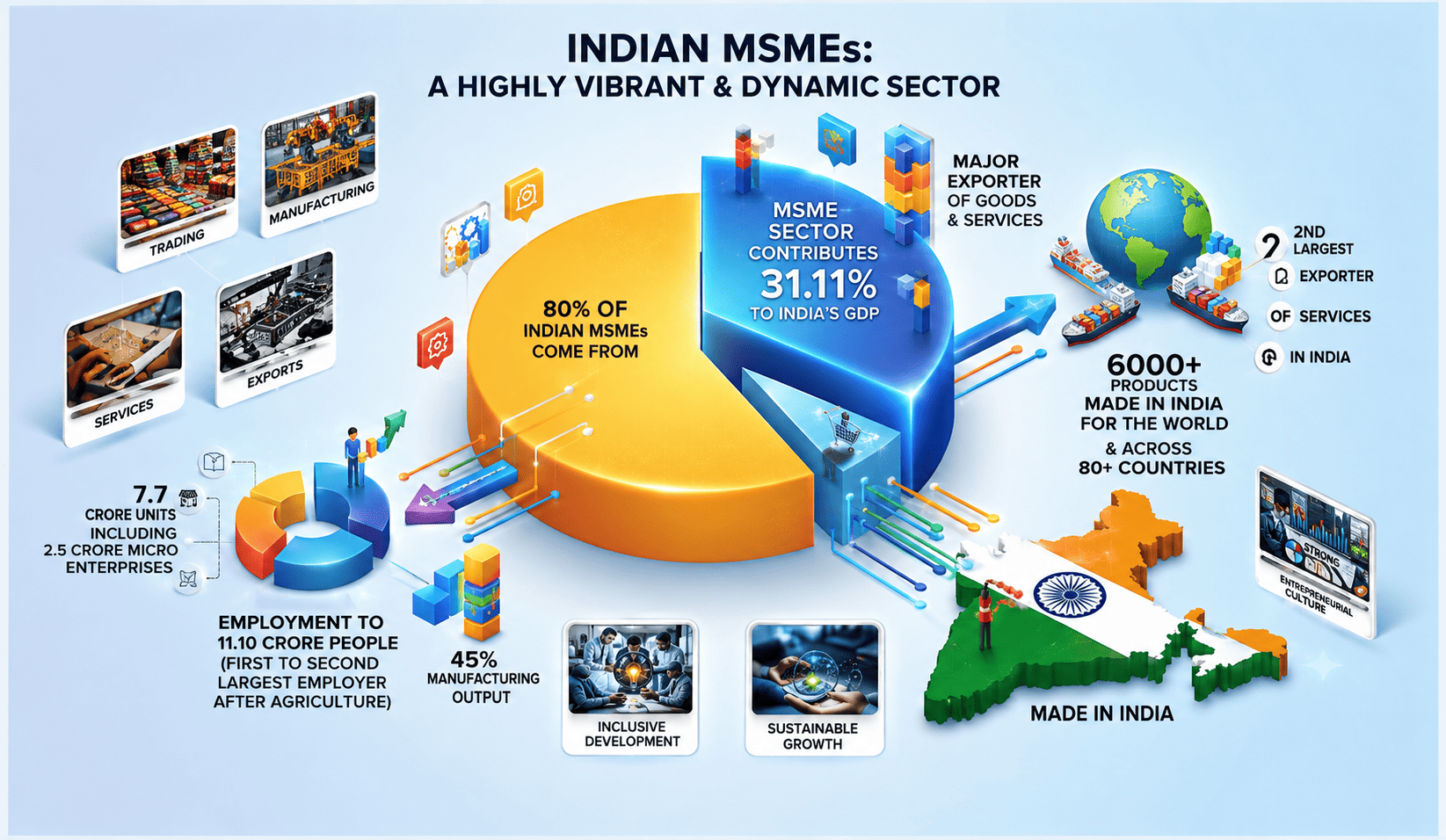
Micro, Small, and Medium Enter‑ prises (MSMEs) emerged as a high‑ ly vibrant and dynamic sector of the Indian economy contributing around 31.1% of India’s GDP, around one‑third in manufacturing and over 48.5% of India’s exports. This sector has been playing a pivotal role in the socio‑economic devel‑ opment of the country by fostering entrepreneurship and generating large employment opportunities at comparatively lower capital cost, next only to agriculture. As per the Ministry of MSME, Government of India, 7.61 crore MSME units are cur‑ rently registered on Udyam Portal providing employment to 33.5 crore people.
Despite the significant contribution of MSMEs in building and develop‑ ing India as a Brand on the global landscape, this sector continues to encounter a number of hurdles, es‑ pecially financial barrier to smooth and accelerated growth. Major fi‑ nancial constraints faced by the In‑ dian MSMEs are as follows:
Financial Constraint of the MSME Sector
- Massive Credit Gap: The sector suffers from a structural credit gap, with industry estimates putting the shortfall at over Rs. 30 lakh crore. This forces many mi‑ cro‑enterprises to rely on high‑ cost informal lending.
- Collateral and Documentation Demands: Formal banking insti‑ tutions frequently require signifi‑ cant tangible assets as collateral. Because smaller firms often lack these, they are regularly deemed ineligible for institutional loans.
- Delayed Receivables: Late payments from buyers severely dam‑ age daily liquidity and cash flow. To mitigate this, tools like the Trade Receivables Discounting System (TReDS) have been intro‑ duced to help MSMEs discount their bills faster.
- High Cost of Credit: When credit is available, smaller businesses are often charged higher interest rates and processing fees com‑ pared to large‑scale corporations due to perceived higher risk pro‑ files.
- Lack of Formalization: A high percentage of micro and small enterprises operate informally without proper balance sheets, audited financial statements, or standardized business records.This lack of transparency heavily limits their ability to secure equi‑ ty or formal bank financing.
- Poor rating of MSMEs:Last but not the least, below investment grade rating of BBB at present is the most prominent bottleneck for the MSMEs to get access to adequate finance needed for business at a reasonable rate. A good rating can solve financial constraints to a significant ex‑ tent.
What is credit rating and how is it done?
A credit rating is an independent assessment of the creditworthiness of a borrower, such as a corporation or government. It evaluates their financial stability and ability to re‑ pay debts. It reflects the financial health, operational efficiency, and risk profile of an enterprise. The rat‑ ing in India ranges from AAA (high‑ est) to D (default).
Importance of Credit Rating for MSMEs
Credit rating plays a crucial role in securing funds, gaining trust, and streamlining the overall MSME pro‑ cess. It facilitates:
- Easier Access to Credit: A good MSME credit rating means high trust and low risk, and hence quick approval as well as disburs‑ al of required credit.
- Better Interest Rates: Lenders view a good rating as reliable to lend and feel confident about ex‑ tending money, leading to lower interest rates and cheaper repay‑ ment.
- Enhanced Market Credibility: A good credit rating establishes as well as enhances business cred‑ ibility in the marketplace and opens doors for business.
Rating process for the MSMEs
The credit rating procedure for MS‑ MEs generally follows the following structured phases:
- Submission of application and required documents by the MSME
- Evaluation of financial and operational data of the firm by rating agency
- Site visits and management interviews by the rating agency
- Assignment of a rating with a validity of one year
Credit rating agencies in India
The following agencies are recog‑ nized by SEBI and RBI for credit rating in India:
- • Credit Rating Information Services of India Limited (CRISIL):
A prominent and highly respect‑ ed agency, CRISIL assigns rat‑ ings to MSMEs based on their creditworthiness relative to other SMEs.
- • Investment Information and Credit Rating Agency of India (ICRA): ICRA is another well‑re‑ garded agency that offers credit ratings to MSMEs.
- • Credit Analysis & Research (CARE) Ratings: CARE provides a range of credit rating services for entities, including MSMEs.
- • India Ratings & Research (a Fitch Group company)
- • Acuite Ratings & Research (formerly SMERA)
- • Brickwork Ratings
- • Infomerics Ratings
CIBIL MSME Rank (CMR)
The Credit Information Bureau (In‑ dia) Limited (CIBIL) provides a score, known as the CIBIL MSME Rank (CMR), specifically for MSMEs with a credit exposure between ₹10 lakh and ₹50 crore. The CMR is a numerical grade from 1 to 10 based on a business’s credit history over 24 months, including its repayment behaviour, and is a part of the Com‑ pany Credit Report (CCR). CMR‑1 indicates the lowest risk of default and CMR‑10 implies maximum risk.
A good CMR can lead to faster loan approvals and better interest rates from banks and non‑banking finan‑ cial companies (NBFCs).
Major Government schemes
MSME is considered a ‘Priority Sec‑ tor’ by the Indian government and a number of support schemes has been introduced to promote this vibrant sector by addressing their financial constraints.
- • Performance and Credit Rating Scheme (PCRS) by the Ministry of MSME and NSIC subsidizes up to 75% of rating fees.1
- • Udyam Registration helps formalize MSMEs and improve their visibility to lenders.2
- • Credit Guarantee Fund Trust for Micro and Small Enterprises (CGTMSE) provide collateral‑free loans.3
- • EXIM Bank offers export‑focused financing options and schemes, such as EMIA and export credit lines, designed to assist MSME exporters.
Key Components of MSME Credit Rating
As credit rating provides a compre‑ hensive evaluation of a business’s creditworthiness and operating reli‑ ability, it is determined by analyzing several core components, including financial strength, operating perfor‑ mance, management capabilities, historical credit behaviour and in‑ dustry outlook of the sector the ap‑ plicant firm belongs to.
- • Financial Performance: Revenue, profit margin and debt levels are the metrics most closely associ‑ ated with your MSME credit rat‑ ing.
- • Operational Efficiency: Efficiently in daily operations like smooth processes, effective cost control, and timely deliveries enhance MSME credit rating.
- • Management Capability: Rating agencies look at experience, decision‑making skills, and crisis management skills as a strong management profile shows sta‑ bility and efficiency.
- • Credit History & Payment Track Record: Rating includes details examination of past repayment behaviours of the firm. Timely payments to suppliers, banks, and other financial institutions indicate a low‑risk profile.
- • Industry Risk: Volatility and inherent risks embedded in differ‑ ent industries are considered by the rating agencies. While a high‑ risk industry may affect the rating, robust internal practices can often offset some of these exter‑ nal risks.
Challenges faced by MSMEs in obtaining good credit ratings
Despite the support initiatives by the government, hurdles in hav‑ ing adequate financial resource at a reasonable rate are not fully addressed. On the financial front, MSMEs are still struggling to avail necessary finance for the following reasons:
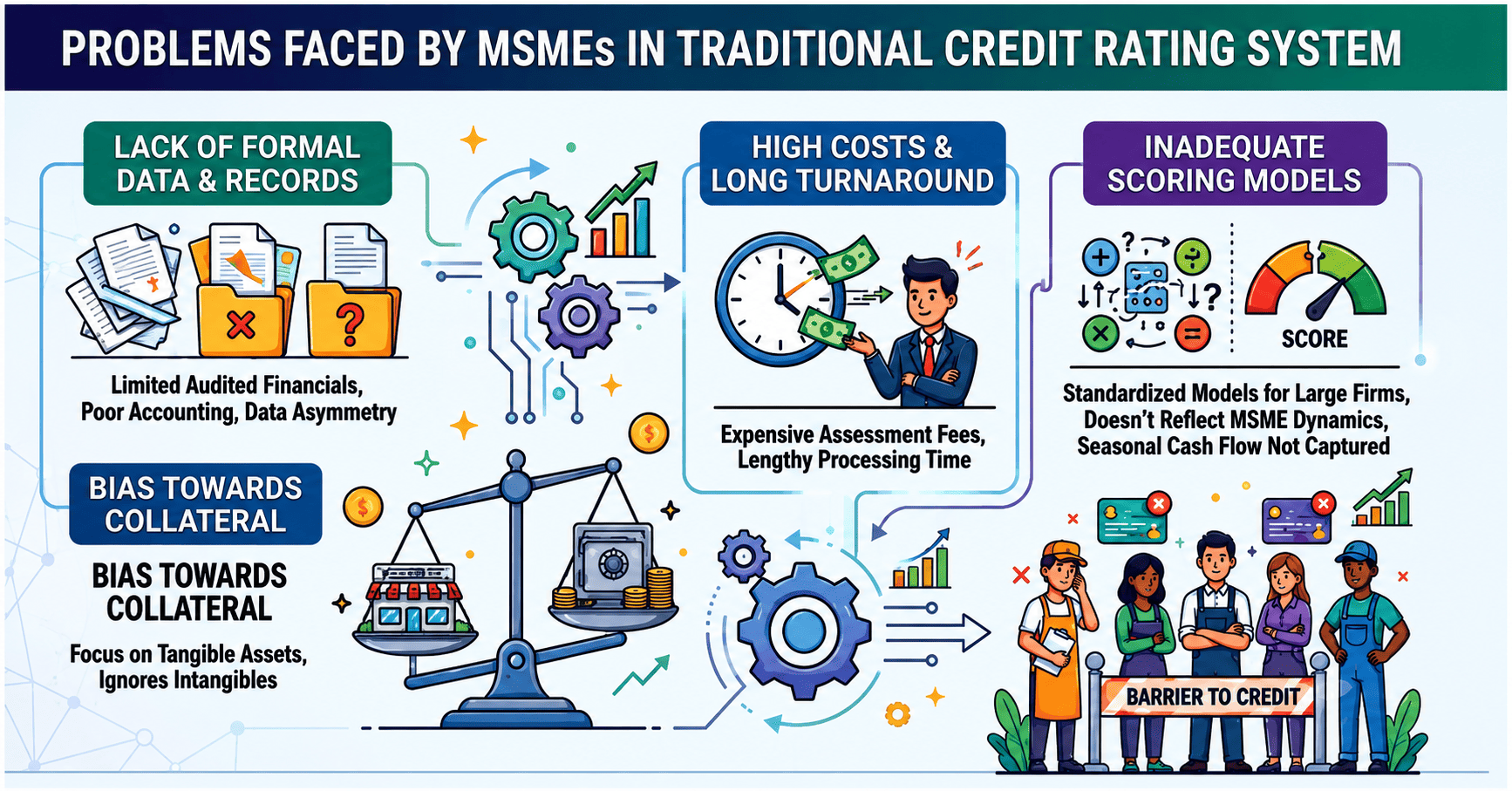
- • Lack of formal financial history: Many MSMEs operate informally and don’t maintain proper books of accounts or audited financial statements, creating a “visibility gap” for lenders.
- • High perceived risk: Lenders often view MSMEs as high‑risk bor‑ rowers due to inconsistent rev‑ enues and informal operations, which can lead to higher interest rates or denial of credit.
- • Collateral constraints: Most small businesses lack the physi‑ cal assets like land or property to use as collateral, a common re‑ quirement for formal loans.
- • Complex and cumbersome processes: The processes for getting loans can be lengthy and involve excessive documentation, caus‑ ing some MSMEs to abandon the application entirely.
- • Poor access and low awareness: In some areas, physical access to financial institutions is limited, and there is a lack of awareness about available loan schemes and digital credit products.
- • Information asymmetry: There is a significant information gap because banks lack sufficient data on MSMEs’ credit history, business models, and financial performance, making it hard to gauge creditworthiness.
Where do the MSMEs Stand in Credit Rating System
Poor credit rating, below invest‑ ment rate grading of BBB at present is the most prominent bottleneck for the MSMEs to get access to ad‑ equate finance needed for business. The most prominent drawback of the traditional credit rating system is that MSMEs are compared with the large scale players of any sec‑ tor. For e.g., when steel sector play‑ ers are rated, MSME steel units are benchmarked against steel giants like Tata Steel and JSW Steel.
Problems faced by MSMEs in traditional Credit Rating System
MSMEs are historically disadvan‑ taged when benchmarked against large corporates in traditional cred‑ it rating models. In such system, in‑ dicators applicable for large‑scale firms like massive global diversifi‑ cation, large balance sheets, and publicly traded equity are applied to the MSMEs while models built for large corporates ignore MSMEs’ flexible cash flows, local market in‑ sights, and informal assets. As a consequence, the system does not reflect actual business position of MSMEs and they are often pushed into non‑investment grades (typ‑ ically rated BB+ / Ba1 or lower).Due to lower rating derives from the traditional rating system, MS‑ MEs are often perceived as high risk and hence, they are asked for much higher collateral against the loan.amount and most importantly, they are not treated eligible to secure the Repo + 200 bps interest rate. A good rating can solve financial con‑ straints of MSMEs to a significant extent.
MSME Rating System of the Banks
Whileproviding loans to MSMEs, the Indian scheduled commercial banks (SCBs) reportedly takes into account both credit rating by exter‑ nal rating agencies as well as their own internal rating system depend‑ ing on the amount of loan. For this purpose, banks generally segregate the loan amount into two segments. One is less than Rs. 5 crore and the other is greater than or equal to Rs. 5 crore.
Loan amount less than Rs. 5 crore – Internal Credit Rating System of the bank is relied upon
In case of a loan amount of less than or equal to Rs. 5 crore, the banks, follow their internal credit rating system rather than credit rating by external credit rating agencies. The Internal Credit Rating system of the banks are usually based on the fol‑ lowing parameters:
- Financial disclosure of the applicant firm including Capital invested, Working capital, Turn‑ over, Profit, Cash flow, debt, eq‑ uity etc.
- Transaction record of the applicant firm with the bank
- Position of the firm in the industry/segment
- Risk associated with the firm
- Risk associated with the industry the applicant firm belong to
Loan amount greater or equal to Rs. 5 crore – Both Internal and External Credit Rating System are considered
In case of loan above Rs. 5 crore, majority of the privately owned SCBs still follow their own internal credit rating system only based on the parameters mentioned above. In some cases, when the loan amount is significantly higher than Rs. 5 crore, Credit rating system by front‑ line rating agencies are considered.
However, many of the nationalized banks reportedly rely on external rating score for a loan amount over Rs. 5 crore where MSMEs are not getting priority due to poor rating as the existing rating system by external rating agencies comprise large scale firms also.
However, this procedure of consid‑ ering external or internal rating sys‑ tem varies from bank to bank under the set of guidelines by RBI.
Interest Subvention for MSMEs: MSMEs get lower interest rate on borrowing in line with Interest
Equalization Scheme (IES) of the government. However, if the MSME applicant firm is not registered with Udyam, the interest rate subsidy is reportedly lower.
Credit rating norms need a rethinking for MSMEs
The traditional credit rating system that includes large scale players as well as the MSME players under the same structure cannot not evaluate the financial position of the MSME players as they are benchmarked against the large scale firms. The following shortcomings of the ex‑ isting system are prominent:
- Some agencies tend to overlook MSMEs’ strengths: Credit rating agencies often focus more on limitations than the unique capa‑ bilities of small businesses.
- MSMEs are frequently labelled high-risk prematurely: Many are judged without a full understand‑ ing of their business models or fi‑ nancial behaviour.
- Traditional rating systems don’t reflect MSME realities: Models built for large corporates ignore MSMEs’ flexible cash flows, local.market insights, and informal as‑ sets.
- Global challenges don’t always mean MSMEs are vulnerable: De‑ spite economic slowdowns and geopolitical tensions, many MS‑ MEs show resilience and adapt‑ ability.
What should be changed in the Credit Rating System
A dedicated credit rating system and benchmark specifically for MS‑ MEs are essential as specialized MSME benchmarks evaluate unique operating realities, localized busi‑ ness cycles, collateral limits, and digital financial footprints to fairly assess creditworthiness. Also, there should be separate categories for rating based on the turnover for the business units. It is suggested to have separate rating systems based on Turnover of Rs. 50 ‑ 150 crore, Rs. 150 ‑ 250 crore and so on. Relative performance of the firms under rating should also be consid‑ ered. In addition, banks, especially the nationalized ones should devel‑ op their own internal credit rating system benchmarked exclusively against the MSMEs rather than rely‑ ing on the traditional external credit rating system while judging the loan application of the MSMEs.
A better credit rating system would let lenders distinguish between genuinely risky firms and otherwise healthy businesses that simply lack formal records. It would also speed up loan approval and reduce de‑ pendence on subjective judgment.
Recommendations
- Create a separate MSME rating scale, so micro and small firms are judged against similar busi‑ nesses rather than large corpo‑ rates.
- Build reliable databases on MSME credit behaviour to reduce infor‑ mation asymmetry.
- Build an MSME‑only risk model with sector‑wise peer groups and size‑based bands.
- Replace generic corporate‑style scoring with a separate MSME creditworthiness index based on verified business data and peer comparisons. That would make ratings fairer, more predictive, and much more useful for lenders and borrowers alike.
- Lower the cost of getting rated, because many MSMEs cannot afford expensive third‑party rat‑ ings.
Advantages for MSMEs with a Credit Rating System exclusively for them
- Easier access to credit: Lenders can assess MSMEs more quickly and confidently, which can speed up loan approvals.
- Lower borrowing cost: Better‑rated MSMEs may receive lower interest rates or more at‑ tractive loan terms.
- Less paperwork and faster processing: A standardized rating can reduce repeated documen‑ tation and shorten turnaround time.
- Better chance of unsecured or lower-collateral funding: A strong rating can improve the odds of getting credit without heavy security requirements.
- Stronger bargaining power: MSMEs with a better rating can ne‑ gotiate higher working capital limits, better repayment terms, and improved bank terms.
- Greater trust and market recognition: A recognized rating can help with suppliers, buyers, in‑ vestors, and export credibility.
- Business improvement insights: The rating process can reveal weaknesses in finances, compli‑ ance, or operations, helping MS‑ MEs improve internally.
Conclusion
As MSMEs are vital to India’s eco‑ nomic resilience and global com‑ petitiveness, holistic development of this sector is critical to sustained economic development of India and addressing the impediments to growth faced by the MSMEs is the need of the hour. It has been evident that lack of accessibility to adequate finance is the most prom‑ inent constraint for this sector and poor credit ratings in one of the reasons that limits access to finance in many cases. A multi‑pronged approach involving separate credit rating structure for MSMEs, regula‑ tory reforms, digital infrastructure, internal bank ratings, and targeted government support is essential to bridge the credit gap and empow‑ er MSMEs to participate more in the development process of India. Timely access to affordable finance will enhance MSMEs’ competitive‑ ness against global peers, which is particularly crucial in the current challenging global environment.



© Copyright , All rights reserved. Design by Andreal