







VOL. 19, ISSUE NO. 2 | May 2026

Tech Story





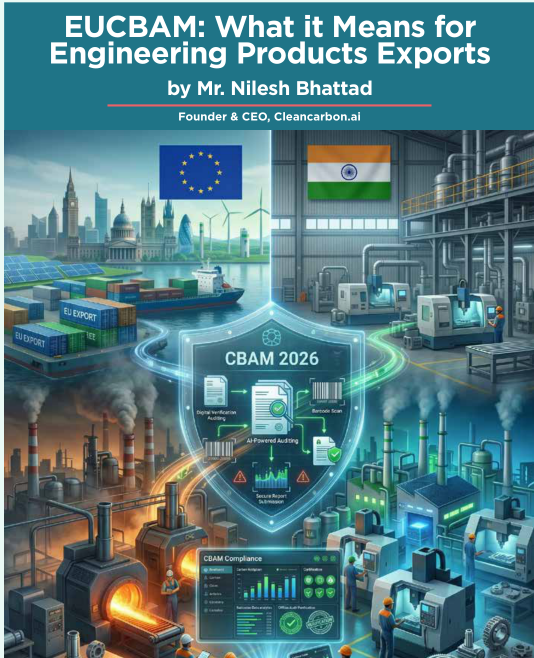
T he EU CBAM (Carbon Bor-der Adjustment Mecha-nism) has entered into a mandatory reporting peri-od from January, 2026. With this, CBAM tax, data auditing and veri-fication, timely submission of re-ports and penalty for inaccurate. CBAM reports become mandatory for EU importers and Indian suppli-ers of engineering products to the EU. On April 7, 2026, the European Union Commission also released the first official CBAM certificate price, which is linked to EUETS. For Quarter 1 CBAM report, the CBAM certificate price will be €75.36 per-tonne of CO (₹8,070-₹8,090 INR).. This clearly substantiates the fact that CBAM is a permanent carbon pricing mechanism impacting both importers and exporters. In simpler terms, higher embedded emissions will lead to increased CBAM cost li-abilities.
CBAM to Prevent Carbon Leakage
The Carbon Border Adjustment Mechanism (CBAM) was introduced by the European Union Commission to prevent carbon leakage, a situ-ation where companies outsource their production to another country with lax climate policies to evade carbon tax and decarbonisation responsibilities. The EU also intro-duced the CBAM to create a level. playing field for all businesses and traders from across the world.
The entire mechanism is a replica of the European Union Emissions Trading System (EU ETS). Current-ly, CBAM is applicable to six high-ly carbon-intensive sectors such as Iron and Steel, Cement. Alu-minium, Electricity, Fertilisers, and Hydrogen. Although CBAM is only applicable to six carbon-intensive sectors currently, it is expected to expand to more sectors in the future.
Why is the Indian Iron and Steel Sector Highly Vulnerable to CBAM Reporting?
The European Union's Carbon Border Adjustment Mechanism (CBAM) represents a significant shift in global trade regulations, es-pecially for India's secondary steel sector, which constitutes 40% of the nation's steel production. With. iron and steel being India's largest CBAM-covered exports to the EU. the financial impact of this regula-tion is substantial, potentially add-ing up to 25% in additional costs
This challenge is particularly critical for India's MSMEs in the secondary steel sector, which are already fac-ing barriers like low awareness and gaps in emissions data collection
However, CBAM also presents an opportunity to innovate and adopt low-carbon technologies, helping the sector remain competitive and align with India's Net Zero aspira-tions. The potential impact of CBAM will be felt on India's steel exports even after the Omnibus package, focusing on the secondary steel sector, largely composed of micro, small, and medium enterprises (MSMEs).
The total contribution of MSMEs to the GDP is 38%, which indicates the steel sector's role as an economic powerhouse that will witness major ripples. Close examination of this data indicates that close to half of India's GDP will be under impact due to CBAM, causing significant effects on India's economy, trade and business.
India's Steel Exports to the EU: In FY 2022-23, India's iron and steel exports to the EU represented 23.5% of its total steel exports, val-ued at over $13 billion.
Financial Implications: CBAM could impose an additional 25% carbon tax on Indian CBAM-covered goods exported to the EU, including steel, significantly raising costs and reducing competitiveness, as per the Centre for Science and Environment.
Secondary Steel Sector Vulnerability: The secondary steel sector, using energy-intensive methods like Di-rect Reduction Electric Arc Furnace (DRI-EAF), produces higher emis-sions and faces greater risk from CBAM's carbon tariffs.
How Does CBAM Change Steel Exports?
EU CBAM is poised to leave a mas sive impact on the Indian steel sec-tor, and it is going to be critical for small sector players as their eco-nomic outcomes will depend on it. The CBAM rules will result in major changes, as India is the second-larg est crude steel producer in the world, showing a capacity to pro‑ duce 179.5 million tonnes of crude steel in the Financial Year 2023‑24, as per the Ministry of Steel report.
Moreover, SMEs constitute 33–35% of India’s crude steel capacity. With this scale of the steel industry un‑ der direct impact, international trade will also witness changes.For instance, India’s iron and steel exports to the European Union stand at 23.5%, as per the latest World Bank data.
In 2023, India ranked 2nd in glob‑ al steel production with an output of 140.8 million tonnes, as per the World Steel in Figures 2024 report.Furthermore, India exported over $13 billion worth of iron and steel in fiscal year 2023, as per the steel export data.
India’s position as the second‑larg‑ est steel producer and a major ex‑ porter highlights its global trade in‑ tegration and business significance.The introduction of CBAM poses compliance challenges for Indian steel exports, especially to the EU, pushing the industry to adopt sus‑ tainable practices to stay compet‑ itive, profitable, and globally rele‑ vant.
India’s Domestic Steel Production and Greenhouse Gas Emissions
India’s steel industry contributes around 2% of the GDP, and the pro‑ duction of finished steel in India in‑ creased by 49% to reach 122.3 mil‑ lion tonnes over the previous year.India’s emission intensity of steel production is at 2.54 tCO2/T Crude Steel (tCO2/TCS), which is significantly higher than the global average of 1.91, as per the Ministry of Steel report.
These figures are expected to wit‑ ness a sharp rise in the coming years due to increasing domestic demand and global requirements.
If we look at the emission levels for which the Indian steel industry is responsible, credible data indi‑ cates that the sector accounts for 10–12% of India’s total emissions.
India’s historical contribution to the accumulation of greenhouse gases (GHGs) is about 4%, despite being home to 17% of the world’s popu‑ lation. Hence, it is critical to de‑ carbonize the Indian steel industry amid the rapidly changing global economy, which is witnessing the development of a stronger cli‑ mate‑conscious mindset.
Major CBAM Challenges for Iron and Steel Companies
The challenges associated with CBAM compliance are multifac‑ eted, requiring the implemen‑ tation of comprehensive sys‑ tems and processes to meet regulatory obligations and make businesses CBAM‑proof.
Here are five key challenges orga‑ nizations face in preparing CBAM reports:
- 1. Limited Market Readiness & Regulatory Familiarity Despite CBAM’s phased roll‑ out, there is a significant knowl‑ edge gap among stakehold‑ ers regarding its operational nuances — especially around emissions boundaries, em‑ bedded carbon calculation, product‑level attribution, and quarterly reporting formats.
A lack of iron and steel sec‑ tor‑specific training and institu‑ tional guidance continues to hin‑ der preparedness.
- 2. Precision in Emissions Calculation CBAM compliance requires detailed, process‑level emis‑ sions quantification aligned with EU methodologies.Current practices often lack the granularity and accuracy need‑ ed for product‑wise embedded emissions tracking, particularly in plants with integrated or indirect emission sources.
- 3. Data Integrity and Audit Readiness Generating trace‑ able and auditable emissions data remains a major barrier.
EU regulators demand verifiable, digitized reporting backed by documentation and third‑party validation. Manual or fragmented data capture systems in Indian MSMEs compromise both audit‑ ability and compliance assurance.
4. Shipment‑Level Carbon Traceability CBAM man‑ dates shipment‑wise emis‑ sions disclosures, including invoice‑linked carbon values.
The lack of real‑time tracking, ERP integration, and lifecycle data consolidation creates compliance risks and delays in quar‑ terly reporting cycles.
5. Technology and Infrastructure Gaps A significant share of Indian steel exporters, particularly in the secondary sector, lack the necessary MRV (Monitoring, Reporting, and Verification) infrastructure and digital capabilities.
As the Definitive Regime restricts the use of default values from 2026, real‑time emissions tracking tools, carbon accounting platforms, and automated reporting systems will become critical.
Conclusion
CBAM is a challenge — but also an opportunity for business expansion if the right technology is used. It can drive innovation, clean‑tech adoption, and better global trade alignment.
For India’s steel industry, the time to prepare is now if it wants to avoid a double whammy in the coming years. CBAM is not the only challenge the Indian iron and steel sector faces. The industry is also experiencing increasing pressure from the Green Steel Taxonomy introduced by the Ministry of Steel.
These regulations, coupled with practical setbacks such as inadequate infrastructure, high carbon intensity in the Indian iron and steel sector, and lack of the right technology, are adding to the crisis.
It is critical to invest in the right technology not only to overcome this double challenge but also to use CBAM as an opportunity for business expansion and economic growth.
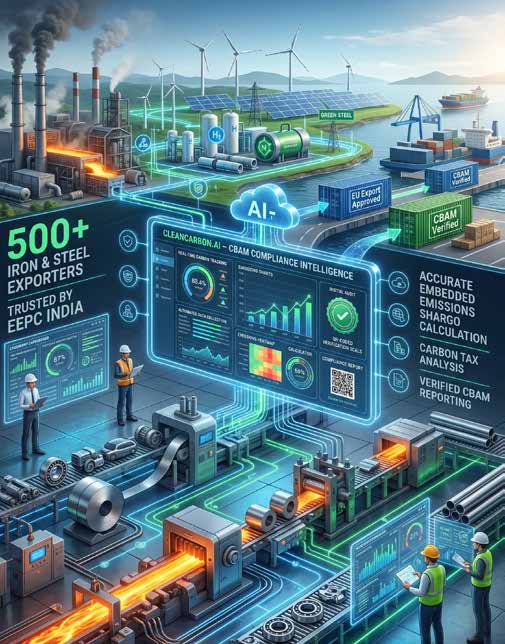
Cleancarbon.ai is one such technology platform trusted by more than 500 iron and steel exporters and EEPC India to help exporters navigate the CBAM landscape and ensure accurate CBAM compliance.It helps in accurate emissions data collection, specific embedded emissions calculation, and carbon tax analysis.
India’s CBAM‑first platform also supports data verification, auditing, reduction of CBAM tax burdens, and timely compliance for exporters.

© Copyright , All rights reserved. Design by Andreal